By Beth Smith, M. Ed | #smithingifted
There is a moment during a Breakout EDU game that every teacher should get to experience.
Students are gathered around a clue.
One student is convinced the answer is a number. Another notices a pattern no one else has seen. Someone is flipping back through a text looking for evidence. A student who rarely volunteers during a traditional lesson suddenly leans across the table and says:
“Wait! I think I figured something out!”
And everyone stops.
Everyone listens.
Everyone leans in.
That is the moment I love.
Because while my students may think they are trying to crack a code, open a lock, or solve a mystery, I know something much bigger is happening.
They are thinking, communicating, questioning, persevering, and learning together.
And for me, that is the real magic of Breakout EDU.


It’s Not Really About the Locks
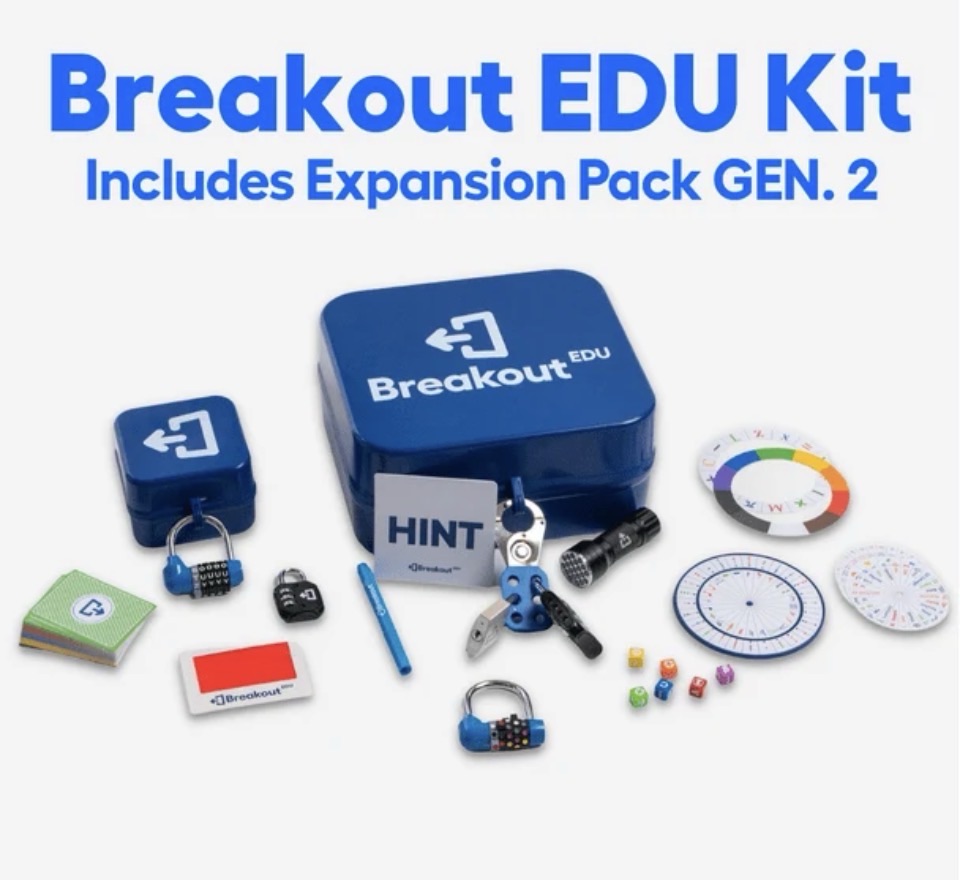
Let’s be clear: students love the locks.
The minute they see the Breakout EDU boxes come out, the energy in the room changes.
But the locks aren’t what make Breakout EDU powerful.
The thinking is.
A strong Breakout EDU experience asks students to do the very things we spend so much time trying to develop in our classrooms:
- Analyze information
- Recognize patterns
- Make connections
- Communicate ideas
- Listen to different perspectives
- Defend reasoning with evidence
- Revise unsuccessful strategies
- Persevere when an answer isn’t immediately obvious
Most importantly, students have to do something with what they know.
They aren’t recalling information simply because the teacher asked them a question.
They need that information because it helps them solve a problem.
That small shift can completely change the learning experience.
When the Lock Doesn’t Open, Learning Begins
One of my favorite things about Breakout EDU is what happens when students confidently enter a combination…
…and the lock doesn’t open.
There is no red X.
There is no grade written at the top of a paper.
There is simply immediate feedback:
Something about our thinking isn’t right yet.
So students go back.
They reread.
They question an assumption.
They compare answers.
They look for details they overlooked.
They argue their case.
They test another idea.
And they try again.
That is productive struggle in action.
For students who are accustomed to getting answers quickly—especially some of our advanced and gifted learners—this experience can be incredibly valuable.
When my students become frustrated, I try very hard not to rescue them.
Instead of giving answers, I ask questions:
What have you already tried?
What evidence supports your answer?
What are you assuming?
Could the clue mean something else?
What haven’t you tried yet?
Who in your group has a different idea?
The goal isn’t frustration for frustration’s sake.
The goal is to help students develop a strategy for one of the most important moments in learning:
What do I do when I don’t know what to do?
That’s a skill students need far beyond any Breakout EDU game.
One Tool. Almost Any Content Area.
Another reason I keep coming back to Breakout EDU is its flexibility.
I can use a game to introduce a new topic, review previously learned material, practice a skill, assess understanding, build teamwork, or bring several content areas together into one challenge.
In Math
Instead of another review worksheet, students can solve problems whose solutions unlock the next part of a challenge.
They might need to:
- Solve multi-step problems
- Compare fractions or decimals
- Analyze graphs
- Recognize numerical patterns
- Solve equations
- Identify errors
- Evaluate possible solutions
Suddenly, students have a very good reason to check their work.
That combination has to work.
In Reading and Language Arts
Breakout EDU and literacy are a natural match.
Students can:
- Make inferences
- Analyze text evidence
- Determine meaning from context
- Identify theme
- Sequence events
- Compare sources
- Examine point of view
- Interpret figurative language
One of my favorite things to hear during a literacy Breakout is:
“Read that part again. There has to be something in there.”
That’s close reading—and I didn’t have to tell them to do it.
In Science
A science Breakout can ask students to classify organisms, analyze diagrams, interpret data, investigate systems, apply vocabulary, or combine evidence from multiple sources to solve a scientific mystery.
Rather than asking students to memorize isolated facts, we can give them a reason to use those facts as evidence.
In Social Studies
This may be one of my favorite places to use Breakout-style learning.
Imagine students investigating:
- Primary sources
- Maps
- Historical photographs
- Timelines
- Quotations
- Artifacts
- Competing accounts of an event
Instead of asking only:
“What happened?”
We can ask:
“What does the evidence suggest happened?”
Now students aren’t just learning history.
They’re investigating it.
Your Students Aren’t the Only Ones Learning
During a Breakout EDU game, I learn a tremendous amount about my students.
I see who immediately takes charge.
I see who quietly notices the clue everyone else missed.
I see who listens.
I see who interrupts.
I see who asks for evidence.
I see who guesses.
I see who changes strategies when something doesn’t work.
I see who gets frustrated.
I see who encourages a teammate.
I see who can explain an idea clearly enough for other people to understand it.
Those observations are valuable.
Sometimes a student who doesn’t shine during a traditional lesson suddenly becomes the strongest problem solver at the table.
Sometimes the student who usually has every answer discovers that another classmate sees patterns they don’t.
Sometimes students realize that being the fastest thinker isn’t nearly as useful as being part of a team that thinks well together.
As a teacher, I get a window into academic understanding, collaboration, communication, executive-function skills, persistence, and problem-solving—all during the same experience.
That is powerful formative information.
Breakout EDU itself highlights kit-based games as opportunities for educators to observe students’ content proficiency as well as social-emotional and executive-function skills. (Breakout EDU)
Beware of the Breakout CEO
Of course, put several students around a locked box and one of them will inevitably decide they are now CEO of the entire operation.
You know the student.
They have the clues.
They have the marker.
They have the lock.
They may also be attempting to have everyone else’s thoughts.
Meanwhile, another student is perfectly happy to become an audience member.
That isn’t collaboration.
So before we begin, I establish an important expectation:
Everyone should be doing some of the thinking.
For some groups, rotating responsibilities help.
Evidence Investigator
Searches for important information and supporting details.
Pattern Detective
Looks for relationships, sequences, symbols, and possible codes.
Recorder
Tracks combinations and strategies the group has already attempted.
Questioner
Challenges assumptions and asks teammates to explain their reasoning.
Lock Manager
Enters a combination once the team agrees on a solution.
The goal isn’t rigid roles.
The goal is intellectual participation.
A successful group shouldn’t be one brilliant student followed by four spectators.
Differentiate the Thinking—Not Just the Amount
Breakout EDU also offers a natural opportunity for differentiation.
For students who need additional support, I might provide:
- Vocabulary assistance
- Visual cues
- Structured hints
- Reduced answer choices
- Strategic grouping
- Partially completed organizers
But when students need greater challenge, I don’t want to simply give them more work.
I want to make the thinking more complex.
I might challenge students to:
- Solve a clue two different ways
- Identify irrelevant information
- Prove why another answer is incorrect
- Find a second possible interpretation
- Evaluate whether a clue is fair
- Redesign an existing clue
- Add a constraint
- Create a clue another team must solve
And then I can ask one of my favorite questions for advanced learners:
“Can you make this better?”
That question changes the level of thinking almost immediately.
The Next Level: Stop Playing and Start Designing
Eventually, I want students to make the transition from game players to game designers.
That’s where things get really interesting.
Breakout EDU’s Game Design Studio allows students to create their own digital games, giving them opportunities to develop stories, construct clues, choose locks, test ideas, and share their finished games with others. (Breakout EDU)
And creating a good puzzle is much harder than solving one.
Students suddenly have to think about:
Content
What does the player actually need to understand?
Evidence
What information will the player receive?
Challenge
What thinking will the player have to do?
Design
How can I communicate the clue without simply giving away the answer?
Logic
Does the solution actually make sense?
Testing
Can another person solve it?
Revision
What needs to change after someone tries it?
Now students aren’t simply demonstrating that they know the content.
They’re using the content to create an experience for someone else.
That requires a completely different depth of understanding.
Then Let Someone Break Their Breakout
This might be my favorite part.
Once students create a game, don’t let the assignment end there.
Give them an authentic audience.
Have another group play it.
Because nothing reveals a design problem faster than watching someone else try to understand your brilliant idea.
Suddenly:
“But that’s what I meant!”
isn’t enough.
If players can’t understand the clue, the designers have to reconsider it.
Was the clue too vague?
Was important information missing?
Were there multiple possible answers?
Was it too easy?
Was it impossibly difficult?
Did the storyline make sense?
Students receive authentic feedback and have an authentic reason to revise.
That’s not revision because the teacher wrote “add more details” on the paper.
That’s revision because the product needs to work.
And that’s a big difference.
Breakout EDU currently promotes student game design for exactly this kind of active creation and content demonstration, including using games as alternatives to traditional projects and assessments. (Breakout EDU)
Don’t Skip the Debrief
The lock opens.
The class cheers.
Someone celebrates like they just won the Super Bowl.
And it’s tempting to stop there.
Don’t.
The debrief may contain some of the richest learning of the entire experience.
After a game, I like to ask:
Which clue was most difficult? Why?
What did your team do when your first idea didn’t work?
When did you have to change your thinking?
Whose idea changed the direction of your group?
What evidence helped you solve a problem?
What mistake actually helped your team?
Did everyone participate? How do you know?
What would your group do differently next time?
And for older or advanced learners:
Which mattered more today—knowing the content or knowing how to think? Defend your answer.
Now students aren’t only reflecting on whether they escaped.
They’re reflecting on how they learned.
That’s the part I want them to carry into the next challenge.
Starting Your First Breakout? Keep It Simple.
If you’re new to Breakout EDU, you don’t need to transform your classroom into an elaborate escape room overnight.
You don’t need dramatic lighting.
You don’t need costumes.
You don’t need ten puzzles.
You definitely don’t need a fog machine.
Although the fog machine would be pretty fun.
Start with one experience connected to something your students are already learning.
Set clear expectations.
Create thoughtful groups.
Introduce the challenge.
Then do something teachers aren’t always very good at doing:
Step back.
Observe.
Listen.
Take notes.
And when students look at you desperately and ask:
“Is this right?”
Try answering:
“What evidence do you have?”
When they say:
“We don’t know what to do!”
Try:
“What do you know so far?”
And when the lock doesn’t open?
Resist the temptation to fix it for them.
Because that may be the exact moment when the most important learning is about to happen.
Sometimes the Best Learning Really Is Locked
Our students are going to encounter problems that don’t come with answer keys.
They will face situations where their first solution doesn’t work.
They’ll work alongside people who think differently.
They’ll encounter incomplete information.
They’ll make mistakes.
They’ll need to ask better questions.
They’ll need to communicate, analyze, evaluate, create, test, revise, and try again.
Those aren’t simply Breakout EDU skills.
They’re learning skills.
They’re workplace skills.
They’re life skills.
So yes, when I bring out Breakout EDU, my students are thinking about locks.
They’re thinking about clues.
They’re thinking about beating the clock and solving the mystery.
But I’m watching for something else.
I’m watching students discover that when an answer isn’t immediately obvious, they are capable of thinking their way forward.
And that may be the most important thing we unlock.
Ready to Unlock It in Your Classroom?
Choose one lesson you’re teaching soon.
Not ten.
One.
Ask yourself:
Could my students investigate this instead of simply receiving it?
Could they solve something instead of just answering questions about it?
Could they collaborate, test ideas, make mistakes, and revise their thinking?
Then find a Breakout EDU experience that fits—or challenge your students to eventually design one of their own.
Start with the locks.
Then watch what happens when students realize they hold the keys.
About the Author
Beth Smith is a gifted education teacher, professional development presenter, and creator of #smithingifted, where she develops resources and ideas designed to challenge students to think deeply, solve authentic problems, create, collaborate, and embrace productive struggle. She works with elementary gifted learners and is passionate about bringing STEM, robotics, inquiry, game-based learning, and real-world problem solving into the classroom. Her favorite learning experiences are the ones in which students stop asking, “Is this right?” and start asking, “What should we try next?”