Because Real Problem Solving Starts When the Plan Stops Working
By Beth Smith, M. Ed. | #smithingifted
One of my favorite things to tell students is:
“If everything works exactly the way you planned, you probably didn’t have to think very hard.”
That is exactly why I use Disruption Cards in my gifted classroom.

Gifted students are often very good at figuring out the “right” answer. Give them directions, materials, and a clear goal, and many of them can move quickly from Point A to Point B.
But engineering, innovation, and real-world problem solving rarely work that way.
Plans change.
Materials disappear.
Budgets get cut.
A design works for one person but not another.
Something breaks.
A new requirement suddenly appears.
And that is where the real thinking begins. ⚡
What Are Disruption Cards?
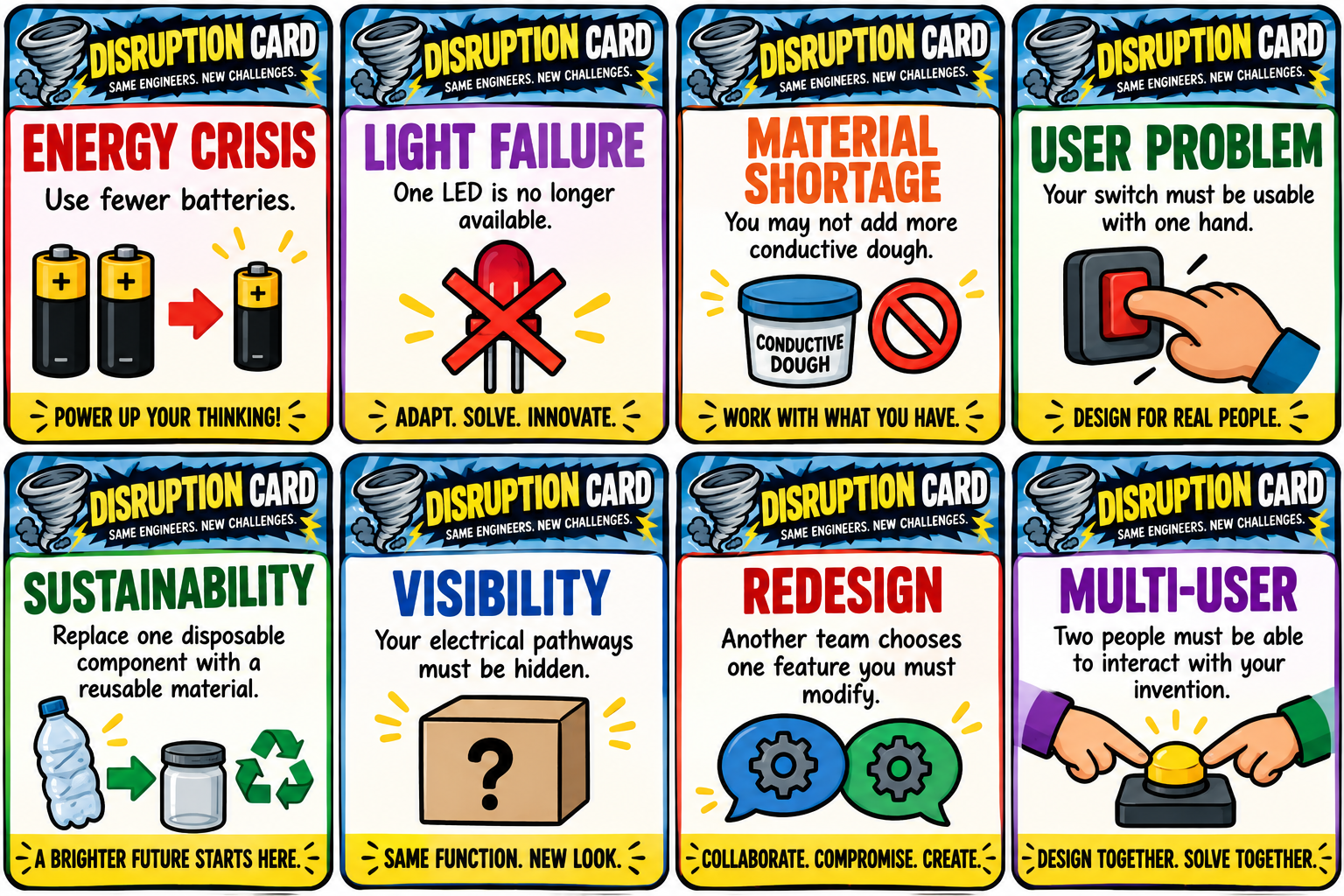
Disruption Cards are unexpected constraints I introduce after students have already started designing or building.
Students might be halfway through a STEM challenge when suddenly they draw a card that says:
- Energy Crisis: Use fewer batteries.
- Light Failure: One LED is no longer available.
- Material Shortage: You may not add more conductive dough.
- User Problem: Your switch must be usable with one hand.
- Sustainability: Replace one disposable component with a reusable material.
- Visibility: Your electrical pathways must be hidden.
- Redesign: Another team chooses one feature you must modify.
- Multi-User: Two people must be able to interact with your invention.
And just like that, the project changes.
Students can no longer simply finish the design they already planned.
They have to rethink it.
That is the point.
I do not use Disruption Cards to make a project harder just for the sake of making it harder.
I use them to increase the thinking complexity.
There is a big difference.
For gifted learners, differentiation should not always mean:
“Here are more pieces.”
“Do another page.”
“Build something bigger.”
“Add five more components.”
Sometimes the most powerful differentiation is:
Use the same materials—but solve a more complicated problem.
That is exactly what a Disruption Card does.
Disruption Cards Force Flexible Thinking
A student may have a perfectly good design.
Then suddenly:
You cannot use another battery.
Now the question changes from:
“Can you make this work?”
to:
“Can you make this work with fewer resources?”
That small change requires a very different level of thinking.
Students may have to reconsider:
- circuit configuration
- material use
- efficiency
- placement of components
- user interaction
- reliability
- overall design
They begin asking questions like:
What part is absolutely necessary?
What could we remove?
Could we rearrange the system?
Is there another way to accomplish the same goal?
Those are much more interesting questions than simply asking:
“Does it work?”
They Make Failure Useful
Gifted students sometimes struggle with failure for a very understandable reason:
They are used to being successful.
When something suddenly does not work, their first response can be frustration.
Disruption Cards help normalize the idea that:
Problems are part of the design process.
If a student loses an LED because of a Light Failure card, nobody did anything wrong.
The design simply has a new constraint.
Now students have to respond like engineers.
They must:
observe → analyze → modify → test → improve
Instead of thinking:
“My project is ruined.”
they begin thinking:
“Okay. What can we change?”
That shift is huge.
They Build Real Engineering Habits
Engineers rarely get unlimited time, unlimited money, unlimited materials, and unlimited freedom.
Real engineering involves constraints.
A product may suddenly need to:
- cost less,
- use less energy,
- fit into a smaller space,
- work for more users,
- use different materials,
- meet new safety requirements,
- or solve an unexpected problem.
When students experience those same kinds of constraints in a classroom STEM challenge, the project becomes much more authentic.
The goal is no longer:
Build the thing.
The goal becomes:
Build the thing. Test it. Defend it. Adapt it. Improve it.
That is a very different learning experience.
They Reveal Student Thinking
One of my favorite parts of using Disruption Cards is watching what students do after they receive one.
That moment tells me so much.
Some students immediately start rebuilding.
Others stop and analyze.
Some students argue for protecting one part of the design.
Others quickly abandon the original idea.
Some teams generate several alternatives before touching anything.
As a teacher, that gives me a window into their thinking.
I can ask:
What do you know is still working?
Which part of your design is most important?
What evidence supports that decision?
What could you change without affecting the entire system?
Could there be more than one solution?
Suddenly I am not directing the project.
I am facilitating the thinking.
And that is exactly where I want to be.
My Favorite Rule: Do Not Rescue Them Too Quickly
This may be the hardest part.
When students hit a problem, teachers naturally want to help.
We see the loose wire.
We notice the backward LED.
We already know why the design will not work.
But if I fix it for them, I have just taken away the most valuable part of the lesson.
So instead of saying:
“Your LED is backwards.”
I might ask:
“What do you know is working?”
“What changed between your last test and this one?”
“What variable could you test first?”
“How could you prove that idea?”
The goal is not to create frustration.
The goal is to create productive struggle.
There is a difference.
Disruption Cards Change the Definition of Success
Without a disruption, students sometimes think success means:
✅ The LED lit.
✅ The robot moved.
✅ The structure stood.
✅ The challenge is finished.
With a disruption, success becomes something deeper.
Students begin to see success as:
✅ I identified the problem.
✅ I generated another solution.
✅ I used evidence.
✅ I adapted my design.
✅ I improved the system.
✅ I can explain why my solution works.
That is the kind of success I want gifted students practicing.
The Best Question Is Not “Did It Work?”
The better questions are:
Why did it work?
Why didn’t it work?
What changed?
What evidence do you have?
Could you solve the problem another way?
What happens if I remove something?
Can you make it simpler?
Can you make it more efficient?
Can you make it better?
That is where the learning lives.
Because the goal is not the light.
The glowing LED is simply evidence.
The goal is the thinking that happens around it.
The questioning.
The redesigning.
The debating.
The testing.
The failure.
The second attempt.
The third attempt.
The moment a student suddenly says:
“Wait…I have another idea.”
That is why I use Disruption Cards.
💛 Same materials. New constraints. Deeper thinking.
#smithingifted
Build it.
Test it.
Disrupt it.
Question it.
Improve it.

