Beth Smith, M. Ed. | #smithingifted
STEP 1: Choose a Question Worth Arguing About
This is the most important step.
Do not start with a question that has one obvious answer.
Avoid:
What did the character do?
Instead, ask something like:
Was the character’s decision justified?
Is progress always an improvement?
Which is more important: individual freedom or responsibility to the community?
Does technology solve more problems than it creates?
When, if ever, is breaking a rule the right thing to do?
For gifted learners, I want the question to contain tension.
There should be reasonable evidence for more than one position.
🌟 #smithingifted rule:
If everybody can agree immediately, the question isn’t ready yet.
STEP 2: Give Students Something to Think With
Students need a common source:
- Short story
- Novel chapter
- Article
- Primary source
- Historical event
- STEM problem
- Scientific controversy
- Photograph
- Data set
- Video
- Current issue
- PBL experience
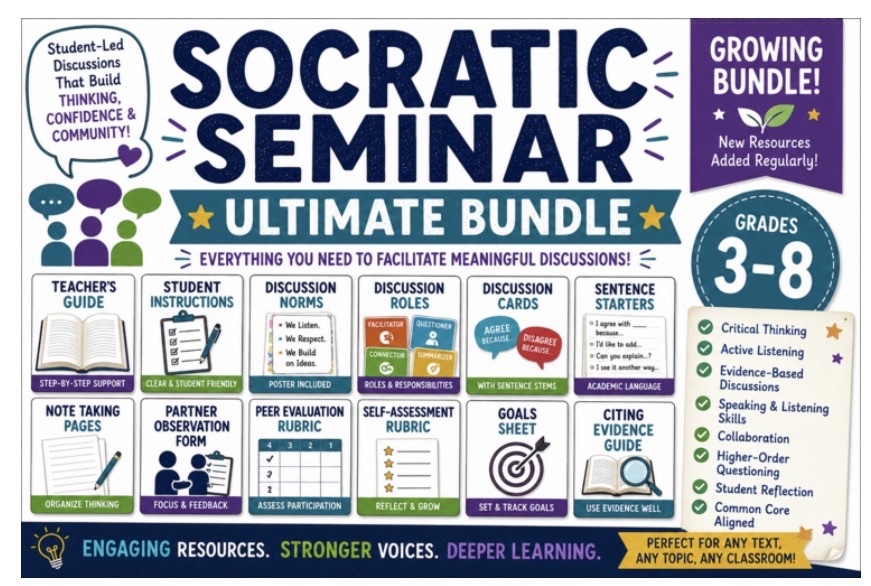
Your bundle is designed to work across ELA, social studies, science, STEM, inquiry, PBL, literature circles, and gifted education rather than being tied to one particular text.
Tell students:
“Today you are not reading to find the answer. You are reading to find evidence that will help you think.”
That tiny distinction matters.
STEP 3: Students Annotate BEFORE They Discuss
Never throw students into the circle cold.
Give them time to prepare.
Using the Discussion Note-Taking Pages and Citing Evidence Guide from the bundle, have students identify:
🔍 Three pieces of evidence
Something that supports an important idea.
❓ Two questions
Something they genuinely wonder about.
⚡ One tension
Something contradictory, surprising, unfair, confusing, or debatable.
🔗 One connection
Something connected to another text, event, idea, experience, or issue.
🤔 One possible position
What do they currently think?
I deliberately say currently.
Their position is allowed to change.
That’s the whole point.
STEP 4: Teach the Difference Between a Discussion and a Performance
Gifted students sometimes think seminar means:
“I need to say something impressive.”
Nope.
Teach this instead:
A strong seminar participant:
- Listens.
- Thinks.
- Refers to evidence.
- Builds on ideas.
- Asks questions.
- Challenges reasoning.
- Invites other perspectives.
- Changes their mind when evidence warrants it.
The bundle includes Discussion Norms Posters, Discussion Rules Handouts, Discussion Expectations, and Checklists for explicitly teaching these behaviors.
I would introduce one big rule:
🗣️ TALK TO EACH OTHER — NOT TO ME.
Students should not finish a response and immediately look at the teacher for approval.
That habit has to be broken.
STEP 5: Establish the Seminar Norms
Before the first seminar, explicitly teach about 5–7 non-negotiables.
For example:
THE #SMITHINGIFTED SEMINAR NORMS
- Listen to understand, not simply to respond.
- Use evidence whenever possible.
- Disagree with ideas, never people.
- Build on what someone else said.
- Ask questions that make the group think deeper.
- Make room for other voices.
- You may change your mind.
That last one is huge.
Tell them:
Changing your position because someone gave you better evidence is intellectual strength—not losing an argument.
STEP 6: Give Students Academic Language
Especially in grades 3–5, students need language before we expect sophisticated conversation.
Your bundle contains Agree & Disagree Sentence Stems and Academic Conversation Sentence Starters.
Teach students phrases such as:
AGREE
“I agree with ___ because…”
“I want to build on ___’s idea…”
“That connects to…”
DISAGREE
“I see it differently because…”
“I understand your reasoning, but…”
“What evidence makes you think that?”
QUESTION
“Can you explain what you mean by…?”
“What would happen if…?”
“Would that still be true if…?”
EVIDENCE
“My evidence is…”
“The text suggests…”
“On page ___…”
“One detail that supports that idea is…”
PUSH THE THINKING
“Is there another perspective?”
“What assumption are we making?”
“Does that always have to be true?”
“What might someone disagree with?”
Now students have something far better than:
“I agree.”
😂
STEP 7: Set One Personal Discussion Goal
Use the bundle’s Goal Setting Sheet before students enter the seminar.
Students choose one goal.
For example:
Today I will ask at least two questions.
Today I will use evidence three times.
Today I will speak even though speaking in groups is difficult for me.
Today I will invite someone else into the conversation.
Today I will disagree respectfully.
Today I will build on someone else’s thinking instead of starting a new topic.
This creates individual accountability without turning the seminar into a participation-point contest.
STEP 8: Arrange the Room
My favorite setup for beginning seminars is the Fishbowl.
Your bundle specifically includes Fishbowl Observation Forms and Fishbowl Discussion Strategies.
Inner Circle
Students conduct the seminar.
Outer Circle
Students observe.
But the outer circle is not sitting there doing nothing.
Each outer-circle student watches one partner and records things like:
- Evidence used
- Questions asked
- Ideas built upon
- Respectful disagreements
- Strong thinking moves
- Opportunities missed
Then switch circles.
This is especially useful for grades 3–5.
By grades 6–8, you may move toward larger whole-class seminars.
STEP 9: Launch With ONE Big Question
Students sit down.
Notes are ready.
Teacher says something like:
“Our central question today is…”
Then ask the question.
And here’s the difficult teacher move:
Stop talking.
Seriously.
Wait.
Let the silence become uncomfortable.
Someone will eventually speak.
Do not rescue them.
That silence is thinking time.
STEP 10: Become the Facilitator — Not the Discussion Leader
Your bundle includes a Facilitation Guide, Teacher Tips, Implementation Suggestions, and Assessment Ideas.
During the seminar, your job changes.
You are watching for:
🧠 Reasoning
Are students explaining why?
📚 Evidence
Are statements supported?
🔄 Connections
Are ideas building?
👀 Perspective
Are multiple viewpoints being considered?
❓ Questioning
Are students asking genuine questions?
🎧 Listening
Are students responding to each other or simply waiting to speak?
Try very hard not to say:
“Good point.”
“Exactly.”
“That’s correct.”
Because the second you do that, students start performing for you again.
Instead, if intervention is necessary:
“Who can respond to that?”
“What evidence supports that?”
“Does anyone see it differently?”
“What assumption are we making?”
Then disappear again.
STEP 11: Use Discussion Cards When Conversation Gets Stuck
This is where your bundle’s Discussion Cards can become extremely useful.
If conversation starts becoming repetitive, pull a challenge.
For example:
🔍 EVIDENCE
Find evidence that weakens the current argument.
👓 PERSPECTIVE
Whose perspective have we not considered?
🔄 REVERSE
Argue the opposite position.
⚖️ WEIGH IT
Which piece of evidence is strongest? Why?
💥 DISRUPT
What assumption is the group currently making?
🔮 CONSEQUENCE
If this idea were implemented, what might happen next?
That immediately raises the cognitive ceiling.
STEP 12: Add the #smithingifted Gifted Level-Up
This is where I would intentionally differentiate the seminar.
The product includes extensions for advanced learners and gifted education strategies.
Instead of simply asking gifted students for more answers, ask them for more sophisticated thinking.
Give students challenges like:
LEVEL 1 — CLAIM
State your position.
LEVEL 2 — EVIDENCE
Support it.
LEVEL 3 — COUNTERARGUMENT
Explain the strongest argument against your own position.
LEVEL 4 — ASSUMPTION
Identify an assumption underlying the discussion.
LEVEL 5 — PERSPECTIVE
Analyze the issue from another stakeholder’s viewpoint.
LEVEL 6 — SYSTEM
What larger system is influencing this problem?
LEVEL 7 — CONSEQUENCE
What unintended consequence could result?
LEVEL 8 — SYNTHESIS
Create a new position that combines ideas from multiple perspectives.
Now we’re getting into gifted territory. 🔥
STEP 13: Let Students Challenge the QUESTION
This is one of my favorite gifted seminar moves.
Near the end, ask:
“Is our original question even the right question?”
Students may discover that the question itself contains assumptions.
For example:
Original question:
Was the character right or wrong?
Students might decide:
“Maybe right versus wrong oversimplifies the situation.”
YES.
That is exactly the kind of thinking we want.
STEP 14: End With a Synthesis Round
Do not end simply because time is up.
Ask every student to complete ONE statement:
🧠 THINKING SHIFT
“At the beginning I thought ___, but now…”
or
💡 BIGGEST IDEA
“The most important idea I heard today was…”
or
❓ UNANSWERED QUESTION
“I am leaving still wondering…”
or
🔗 CONNECTION
“This conversation connects to…”
Keep these brief.
The seminar should end with intellectual residue—something students continue thinking about afterward.
STEP 15: Students Reflect
Your bundle includes Reflection Pages and Self-Assessment Rubrics.
Have students answer:
Did I meet my goal?
What did I contribute?
Whose idea changed or challenged my thinking?
What evidence influenced me?
Did my thinking change? Why?
What will I do differently next seminar?
This piece is critical.
Without reflection, students often think:
“We talked for 30 minutes.”
With reflection, they begin recognizing:
“I’m becoming a better thinker.”
STEP 1: Choose a Question Worth Arguing About
The bundle includes Peer Evaluation Rubrics and Partner Observation Forms.
Keep feedback specific.
Instead of:
You did good.
Try:
You asked questions that moved the discussion forward.
You used strong evidence.
You spoke several times, but could work on inviting others into the conversation.
You listened carefully because you referred back to Emma’s earlier point.
Now students begin learning what quality discussion actually looks like.
STEP 17: Teacher Assessment
Do not grade students based only on how many times they talked.
That’s unfair to thoughtful introverts and rewards students who dominate.
Instead assess things like:
Skill
What You’re Looking For
Reasoning
Explains thinking
Evidence
Supports claims
Questioning
Asks meaningful questions
Listening
Responds to others
Connections
Builds ideas
Perspective
Considers other viewpoints
Collaboration
Makes space for others
Reflection
Evaluates own thinking
The bundle includes both assessment ideas and rubrics to support this accountability piece.
STEP 18: Slowly Remove the Scaffolds
This is the ultimate goal.
Seminar #1
Teacher models heavily.
Seminar #2
Students use sentence stems and cards.
Seminar #3
Teacher intervenes less.
Seminar #4
Students begin questioning one another naturally.
Seminar #5+
The students largely run it.
And eventually you should be able to give them:
A text.
A provocative question.
Preparation time.
And then hear:
“What evidence supports that?”
“I disagree with your assumption.”
“Wait—that connects to what Maya said earlier.”
“I hadn’t thought about it from that perspective.”
“Actually, I think I’m changing my position.”
🎯 THAT is the #smithingifted goal.
Not students who know every answer.
Students who know how to think when the answer isn’t obvious.
Socratic Seminar Ultimate Bundle is especially well suited for building toward that autonomy because it combines preparation tools, academic language, discussion structures, evidence supports, Fishbowl observation, gifted differentiation, rubrics, and reflection rather than treating seminar as simply “put the desks in a circle and talk.”
My favorite #smithingifted seminar formula:
PREPARE → QUESTION → EVIDENCE → CHALLENGE → CONNECT → REVISE → REFLECT
And I would put this sentence on the classroom wall:
🧠 The goal of a Socratic Seminar is not to win the conversation. It is to leave the conversation thinking differently.

View the Socratic Seminar Ultimate Bundle on TPT
Socratic Seminar Ultimate Bundle | Growing Bundle Grades 3-8 by smithingifted on Teachers Pay Teachers

