By Beth Smith, M. Ed. | #smithingifted
One of the biggest shifts we can make in gifted education is surprisingly simple:
Stop doing so much of the thinking for our students.
Gifted students do not need a teacher standing at the front of the room explaining every idea, asking every question, and confirming every correct answer.
They need opportunities to think, question, disagree, defend, reconsider, connect, and revise their thinking.
That is exactly why I love using Socratic Seminar in the gifted classroom.
A well-designed Socratic Seminar transforms your classroom from a place where students answer the teacher’s questions into a place where students begin asking—and wrestling with—their own.
And that is where some of the best gifted learning happens.
What Is a Socratic Seminar?
A Socratic Seminar is a structured, student-led academic discussion centered around an open-ended question, text, problem, idea, primary source, scientific issue, historical event, or real-world challenge.
The goal is not to race toward one correct answer.
The goal is to think more deeply because of the conversation.
Students learn to:
- Ask thoughtful questions
- Support claims with evidence
- Listen actively
- Build upon another student’s thinking
- Challenge ideas respectfully
- Recognize multiple perspectives
- Change their minds when presented with stronger evidence
- Explain their reasoning
- Reflect on how their thinking has changed
That makes Socratic Seminar a natural fit for gifted education.

Why Socratic Seminar Works So Well With Gifted Learners
Gifted students often have plenty of opportunities to demonstrate what they know.
They need more opportunities to discover what they do not know yet.
Socratic Seminar creates that space.
Instead of asking:
“Who knows the answer?”
we begin asking:
“What evidence supports that?”
“Does anyone see this differently?”
“What assumption are we making?”
“What might we be missing?”
“Has anyone changed their thinking?”
Those questions demand a completely different level of intellectual engagement.
Socratic Seminar strengthens many of the skills we should intentionally develop in gifted students:
🧠 Critical Thinking
Students must analyze ideas instead of merely remembering information.
🔍 Evidence-Based Reasoning
Students learn that saying, “I think…” is only the beginning.
The next question becomes:
Why do you think that?
👓 Perspective Taking
Gifted students can sometimes become very attached to their first interpretation.
Seminars force students to encounter ideas they may not have considered.
💬 Academic Communication
Students practice explaining complicated ideas clearly and responding thoughtfully to others.
👂 Active Listening
Listening becomes part of the academic task—not simply something students are told to do while waiting for their turn to speak.
🔄 Flexible Thinking
Students discover something incredibly important:
Changing your mind because of new evidence is not losing an argument. It is thinking.
🚀 Intellectual Independence
Ultimately, students begin depending less on the teacher to validate every idea.
That is a huge step toward becoming an autonomous learner.
Socratic Seminar Is NOT Just for ELA
One of my favorite things about Socratic Seminar is that it works almost anywhere.
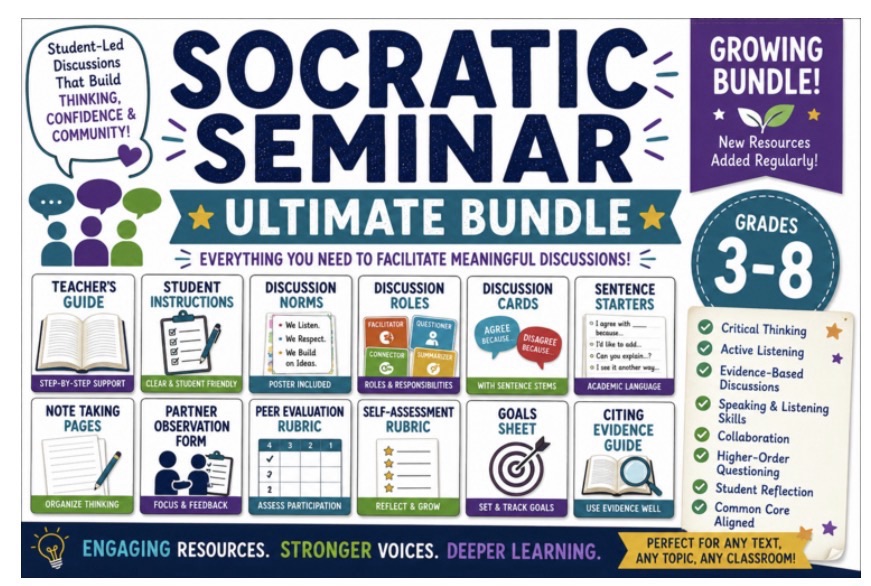
The Socratic Seminar Ultimate Bundle | Growing Bundle | Grades 3–8 was designed for use across multiple subjects, including gifted education, ELA, social studies, science, STEM, and project-based learning. (Teachers Pay Teachers)
Here are some possibilities.
📚 ELA
After reading a novel, short story, article, or poem, move beyond basic comprehension questions.
Instead of asking:
What was the main character’s motivation?
Try:
Was the character’s decision justified?
Or:
Who was actually responsible for the conflict?
Or:
Which character changed the most—and does change always mean growth?
Now students must interpret, defend, compare, and challenge.
🏛️ Social Studies
Historical events are perfect for Socratic Seminar because history rarely fits into neat little boxes.
Try questions such as:
Was this historical decision justified based on what people knew at the time?
Whose perspective is missing from the historical record?
Can an action be legal but still unjust?
Which factor contributed most to this event?
Should we judge historical figures according to today’s standards?
Students quickly learn that studying history involves much more than memorizing names and dates.
🔬 Science
Science gives students tremendous opportunities to examine evidence.
Try questions like:
Should scientists pursue an invention simply because they can?
When should environmental concerns outweigh economic concerns?
Which evidence is strongest?
How much evidence should be required before society changes its behavior?
Does new technology always improve people’s lives?
Now students are thinking about science through the lenses of evidence, ethics, systems, consequences, and decision-making.
🤖 STEM
A Socratic Seminar works beautifully before or after a STEM challenge.
Before Designing
Ask:
What makes a solution successful?
Who should determine whether a design is successful?
Should cost matter more than performance?
After Designing
Ask:
Which constraint had the greatest effect on our designs?
What failure taught us the most?
Is the most technically advanced solution always the best solution?
Students begin analyzing the thinking behind their designs, not merely showing off the finished product.
🌎 Project-Based Learning
Before students begin a major PBL challenge, hold a seminar around the central issue.
Imagine students are investigating water conservation.
Your seminar question might be:
Who is most responsible for conserving water: individuals, businesses, farmers, or governments?
There is no simple answer.
Perfect.
Students enter the project already thinking about responsibility, systems, trade-offs, and competing perspectives.
How I Would Introduce Socratic Seminar in Grades 3–5
Do not expect third graders to walk into a circle on Monday and immediately conduct a college-level seminar.
Socratic discussion is a skill.
Teach it.
Model it.
Practice it.
Then gradually release responsibility.
Step 1: Teach What Good Discussion Sounds Like
Before discussing complicated content, teach students the language of academic conversation.
Students need phrases such as:
I agree with ___ because…
I would like to add to that idea…
I see it differently because…
What evidence supports that?
Can you explain what you mean?
That connects to…
My thinking changed when…
I understand your point, but I interpreted the evidence differently.
The bundle includes agree/disagree sentence stems, academic conversation starters, discussion cards, norms, rules, roles, and student instructions to support this process. (Teachers Pay Teachers)
These supports matter tremendously with younger students.
They give students the vocabulary needed to participate successfully.
Step 2: Start With Low-Risk Questions
Your first seminar does not need to involve a complicated historical document.
Start with something students can discuss immediately.
For example:
Is competition good for students?
Should homework exist?
Is failure necessary for learning?
Which is more important: intelligence or persistence?
Should students be allowed to use AI for schoolwork?
The content is familiar.
That allows students to focus on learning the discussion process.
Step 3: Move From Opinion to Evidence
Gifted students can be excellent opinion generators.
That does not automatically make them excellent reasoners.
Teach this distinction:
OPINION:
I think school uniforms are a bad idea.
REASONING:
I think school uniforms are a bad idea because…
EVIDENCE-BASED REASONING:
Based on the evidence in Source B…
The goal is to continually move students toward:
CLAIM → EVIDENCE → REASONING
A strong seminar should make students realize:
You are allowed to have an opinion. You are not allowed to expect everyone to accept it without reasoning.
Step 4: Try a Fishbowl Seminar
Fishbowl seminars are especially effective when introducing Socratic Seminar.
Create two circles.
Inner Circle
These students conduct the discussion.
Outer Circle
These students observe.
But the observers should have a job.
They might track:
- Who used evidence?
- Who asked a question?
- Who built upon someone’s idea?
- Who respectfully disagreed?
- Who invited another student into the conversation?
- Who changed or refined an idea?
Then switch groups.
The bundle includes partner observation and Fishbowl observation forms along with student self-assessment, peer evaluation, goal-setting, and reflection tools. (Teachers Pay Teachers)
That means students are not just participating in a seminar.
They are learning to analyze the quality of a seminar.
That is a much deeper metacognitive skill.
What Does the Teacher Do During a Socratic Seminar?
This can be the hardest part.
You talk less.
A lot less.
Your students may look at you.
They may wait.
They may assume you are eventually going to rescue them from the silence.
Don’t.
Productive silence is not automatically a problem.
Sometimes students need several seconds to think.
Your job shifts from:
Discussion Leader
to:
Discussion Architect.
Before the seminar, you create the conditions for strong thinking.
During the seminar, students increasingly carry the intellectual load.
You observe.
You take notes.
You assess.
You occasionally intervene if students need redirection.
But resist the temptation to turn every interesting student comment into another teacher-led lesson.
Sometimes the best thing you can do is simply say:
“Who wants to respond to that?”
And get out of the way.
The Three Levels of Socratic Questions
One way I increase rigor is by teaching students to recognize different levels of questions.
LEVEL 1: Understand
These questions usually have answers directly available in the text or information.
What happened?
Who made the decision?
What does this word mean?
Necessary?
Yes.
Gifted-level destination?
No.
LEVEL 2: Interpret
Now students must analyze.
Why do you think the character made that decision?
Which piece of evidence is most significant?
What caused the conflict?
Better.
LEVEL 3: Evaluate and Transfer
This is where gifted discussion gets interesting.
Was the decision justified?
Which perspective is most convincing?
What assumption does this argument depend on?
Would the same decision be acceptable today?
What larger principle can we learn from this situation?
When might the opposite argument be true?
What would change your mind?
Now students are evaluating ideas, thinking conditionally, examining assumptions, and transferring learning.
That is where I want gifted students spending more of their intellectual time.
One of My Favorite Gifted Questions
After students debate an issue, ask:
What evidence would make you change your mind?
That question is powerful.
It forces students to consider whether they are actually reasoning or simply defending a position.
A thinker should be able to say:
“I currently believe X, but if I discovered Y, I would reconsider.”
That is intellectual flexibility.
Try the Devil’s Advocate Challenge
Once students become comfortable with seminars, increase the rigor.
Tell them:
You must defend the opposite side of the position you actually believe.
This is challenging.
Students can no longer rely on personal opinion.
They must understand the opposing argument well enough to defend it fairly.
Then ask:
What did you understand about the opposing perspective that you did not understand before?
That is gifted-level perspective taking.
The Silent Student Is Still Thinking
One mistake teachers can make is assuming that the student who speaks the most is demonstrating the most thinking.
Not necessarily.
Some gifted students process internally before speaking.
Some students are brilliant writers but hesitant speakers.
Some students need time to formulate complex thoughts.
That is why seminar assessment should involve multiple forms of evidence.
The resource includes discussion note-taking pages, goal-setting sheets, self-assessment rubrics, peer evaluation rubrics, observation forms, and reflection pages. (Teachers Pay Teachers)
A student might contribute twice verbally but produce an outstanding reflection demonstrating deep intellectual engagement.
That matters.
Differentiate the Seminar, Not the Thinking
I would not simplify the intellectual question for younger or less confident students.
Instead, change the support.
A third grader might receive:
- Sentence starters
- Question stems
- A discussion role
- Two pieces of evidence highlighted in advance
- A goal to contribute once
- A partner preparation conversation
An eighth grader might be expected to:
- Generate original questions
- Cite several sources
- Identify assumptions
- Challenge reasoning
- Compare competing perspectives
- Synthesize several students’ ideas
- Revise a claim during the seminar
The core idea remains complex.
The scaffolding changes.
That is an important distinction in gifted differentiation.
Try Discussion Roles
Roles can help students become more intentional thinkers.
Possible roles include:
🔍 Evidence Detective
Challenges the group to support statements with evidence.
❓ Questioner
Introduces questions that push the conversation deeper.
🔗 Connector
Connects one student’s idea to another idea, text, topic, or real-world situation.
👓 Perspective Hunter
Looks for missing viewpoints.
⚖️ Devil’s Advocate
Challenges assumptions and presents counterarguments.
🧠 Synthesizer
Periodically summarizes where the group’s thinking has moved.
Eventually, students should be able to perform all of these intellectual moves independently.
But roles are excellent training wheels.
A Powerful Seminar Routine for Gifted Students
Here is a structure you can use again and again.
BEFORE
Students:
- Read, investigate, observe, or research.
- Annotate evidence.
- Generate questions.
- Choose a preliminary position.
- Identify evidence supporting that position.
DURING
Students:
- Ask questions.
- Respond to one another.
- Cite evidence.
- Challenge ideas respectfully.
- Look for multiple perspectives.
- Make connections.
- Revise thinking.
AFTER
Students answer:
What idea challenged my thinking?
What evidence influenced me most?
What did someone else say that I had not considered?
Did my thinking change? Why or why not?
What question do I still have?
What did I contribute to the group’s thinking?
Now the seminar becomes a complete thinking cycle.
Let Students Generate the Questions
Eventually, stop providing all the seminar questions.
Give students a topic, text, phenomenon, or problem.
Then tell them:
Create a question worthy of 20 minutes of discussion.
Teach them that a strong seminar question:
- Cannot be answered with yes or no alone.
- Does not have one obvious correct answer.
- Can be supported with evidence.
- Allows multiple defensible perspectives.
- Encourages additional questions.
- Connects to a larger idea.
Then let the class evaluate the proposed questions.
Ask:
Which question would create the deepest discussion? Why?
Now students are analyzing question quality.
That is a gifted skill in itself.
Make Socratic Seminar Part of Your Gifted Classroom Culture
Do not save Socratic Seminar for a special Friday activity.
Use it regularly.
It can become your:
- Novel study discussion
- STEM reflection
- Science ethics conversation
- Historical inquiry
- Current-events analysis
- PBL launch
- PBL debrief
- Research discussion
- Debate preparation
- Primary-source investigation
- End-of-unit synthesis
- Gifted SEL conversation
- Passion project critique
The TPT resource is intentionally designed to work across subjects and grade levels and can be used with whole-class, small-group, or Fishbowl discussions. (Teachers Pay Teachers)
That flexibility is what makes the routine so powerful.
Students stop thinking:
“Today we’re doing Socratic Seminar.”
Eventually they start thinking:
“This is how we discuss difficult ideas in this classroom.”
That is the goal.
What Socratic Seminar Teaches Beyond the Standards
Yes, Socratic Seminar supports reading, speaking, listening, writing, critical thinking, evidence-based reasoning, collaboration, communication, perspective taking, reflection, and respectful disagreement. Those are among the skills identified in the bundle itself. (Teachers Pay Teachers)
But it also teaches something bigger.
Students learn that intelligent people can disagree.
They learn that confidence and correctness are not the same thing.
They learn that evidence matters.
They learn that asking a strong question can be more intellectually valuable than quickly producing an answer.
They learn that another student’s idea can improve their own.
And they learn that:
The goal of discussion is not always to win. Sometimes the goal is to leave thinking differently than when you entered.
That is exactly the kind of classroom I want for gifted learners.
Ready to Bring Socratic Seminar Into Your Classroom?
If you want the structures already created for you, my Socratic Seminar Ultimate Bundle | Growing Bundle | Grades 3–8 includes teacher and student supports for launching, facilitating, observing, assessing, and reflecting on student-led academic discussions.
The current bundle includes teacher guidance, student instructions, discussion norms and rules, discussion roles and cards, academic conversation stems, note-taking tools, self and peer assessment, Fishbowl observation forms, evidence supports, facilitation resources, differentiation ideas, assessment tools, and more. (Teachers Pay Teachers)
And because it is a Growing Bundle, future additions are included for existing purchasers as the resource expands. (Teachers Pay Teachers)
👉 Socratic Seminar Ultimate Bundle | Growing Bundle Grades 3–8
Available from smithingifted on Teachers Pay Teachers.
#smithingifted
One Final Challenge for Gifted Teachers
The next time your students ask:
“But what’s the answer?”
Try responding:
“What does the evidence make you think?”
Then listen.
They may surprise you.
And more importantly—
they may surprise themselves.


