By Beth Smith, M. Ed. | #smithingifted
One of the biggest shifts I want my gifted students to make is this:
Stop waiting for the teacher to tell you what to do next.
That sounds simple. It isn’t.
Many gifted students are very good at learning quickly, remembering information, and answering questions when the path is clear. But give them a problem with missing information, multiple possibilities, or no obvious first step, and suddenly the real thinking begins.
That is exactly why I love using logic problems with my 3rd grade gifted students.
They are one of the best tools I have found for helping students become more independent, more persistent, and more willing to trust their own reasoning.

Gifted Students Need More Than Harder Work
Gifted education should not be about giving students more problems, more pages, or more work.
It should be about giving students opportunities to think differently.
Logic problems do that beautifully because students cannot simply wait for a formula or copy a procedure. They have to:
- notice information
- eliminate possibilities
- make connections
- test ideas
- recognize contradictions
- revise their thinking
- explain how they know
And sometimes they have to sit with the uncomfortable feeling of:
“I don’t know what to do yet.”
That moment matters.
Productive Struggle Is Part of the Lesson
When I introduce a logic problem, I intentionally do not explain every step.
I may clarify the directions once, but then I want students to begin figuring things out.
At first, I hear things like:
“What do I do?”
“Is this right?”
“Can you just tell me how to start?”
My response is usually another question:
“What do you know?”
“What can you eliminate?”
“Which clue gives you the most information?”
“What would have to be true?”
That is where the growth happens.
The goal is not frustration for the sake of frustration. The goal is productive struggle—a challenge that requires students to think, persist, adjust, and eventually experience the satisfaction of solving something themselves.
Logic Problems Build Deductive Reasoning
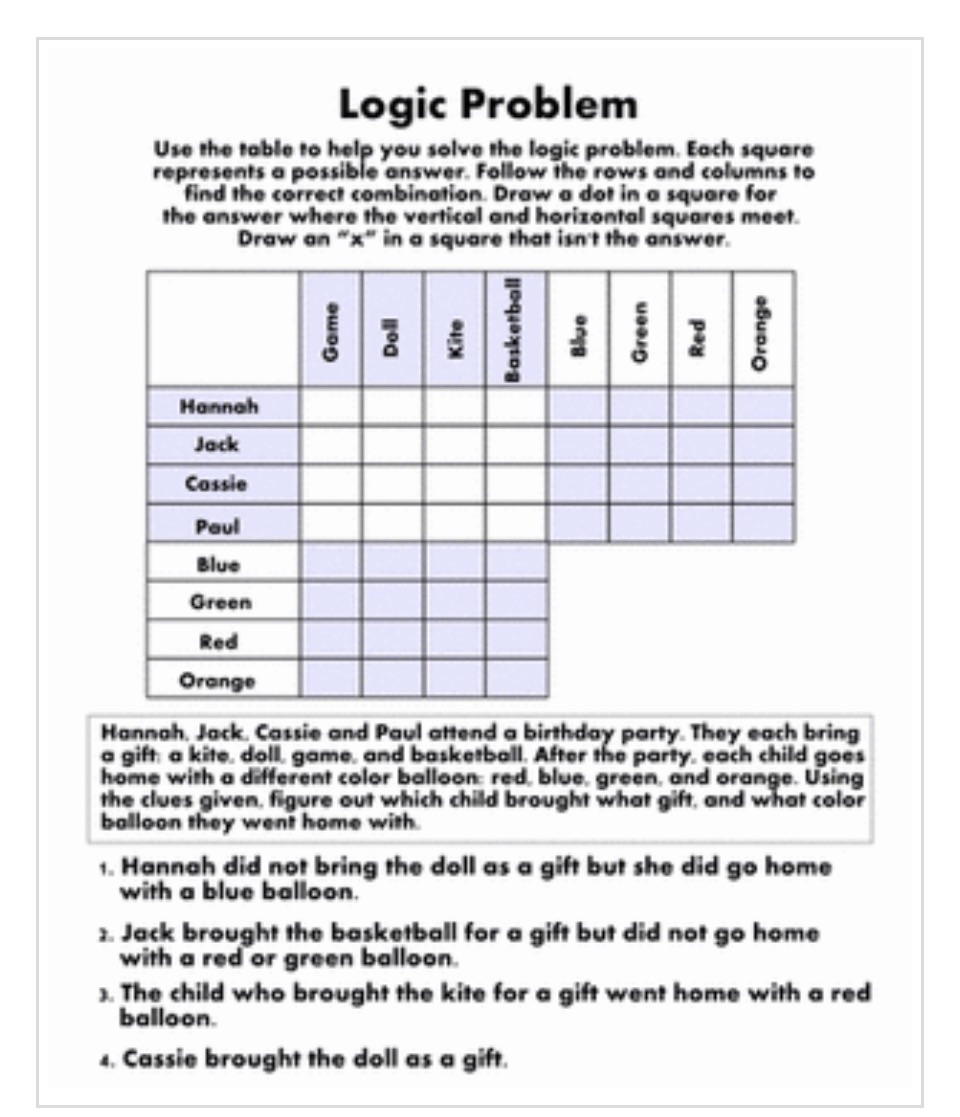
One of the biggest skills I work on with my gifted students is deductive reasoning.
Students need to learn that clues can work together.
For example:
Ava does not have the blue backpack.
Mateo has neither the red nor green backpack.
Liam has the green backpack.
A student may not immediately know Ava’s backpack.
But they can begin eliminating possibilities.
That is deductive reasoning.
They learn to think:
If this is true…
And this is true…
Then this must be true.
That type of thinking transfers far beyond a logic puzzle.
Students use it in:
- mathematics
- science investigations
- reading inference
- research
- coding
- robotics
- debate
- historical investigations
- real-world problem solving
Logic problems are really thinking practice disguised as puzzles.
I Want Students to Stop Asking, “Is This Right?”
This is one of my favorite changes to watch.
At the beginning, students constantly want confirmation.
“Mrs. Smith, is this right?”
Eventually I want them asking:
“Does my evidence prove this?”
That is a very different question.
Instead of depending on the teacher as the authority, students begin depending on evidence and reasoning.
That is a major step toward becoming an autonomous learner.
My Favorite Rule: Prove It
In my classroom, finding the answer is not enough.
Students have to be able to explain:
How do you know?
If a student says:
“The answer is Caleb.”
I may respond:
“Convince me.”
Now the student has to reconstruct the thinking.
Maybe:
“It couldn’t be Ava because clue three says she was at the library. It couldn’t be Marcus because he had the yellow card. That leaves Caleb.”
That explanation is far more valuable than simply circling the correct answer.
Mistakes Become Useful
Logic problems are also excellent for teaching students that changing their thinking is normal.
A student might begin with one possibility and later discover a clue that makes it impossible.
That does not mean the student failed.
It means the student found new evidence.
I want students to become comfortable saying:
“I thought this at first, but then I noticed…”
That is sophisticated thinking.
Strong thinkers revise their ideas when the evidence changes.
How I Introduce Logic Problems in 3rd Grade
I do not begin with complicated multi-page logic grids.
I build gradually.
Start with:
Which One Doesn’t Belong?
What Comes Next?
Who Could It Be?
Mystery Clues
Simple elimination problems
One-variable logic puzzles
Then I move toward traditional logic-grid problems.
The important part is that students learn the thinking habits before the puzzle becomes overly complex.
🕵️ Turn Students Into Thinking Detectives
I love framing logic work as an investigation.
Instead of:
Complete this worksheet.
Try:
You have been assigned a case. Every clue matters. Your job is to determine what must be true.
That small shift changes the energy immediately.
Students become detectives.
Now they are hunting for:
🔎 clues
🧩 patterns
🚫 impossible choices
🔗 connections
💡 conclusions
And suddenly deductive reasoning feels like solving a mystery.
Questions I Ask Instead of Giving Answers
When students get stuck, these are some of my favorite prompts:
- What do you know for certain?
- Which clue eliminates something?
- What can’t be true?
- What information connects?
- Where could you start?
- What happens if you assume that answer is true?
- Does another clue contradict it?
- What haven’t you used yet?
- Can you prove it?
Notice that none of those questions gives students the answer.
They give students a way back into the thinking.
The Long-Term Goal: Autonomous Learners
Ultimately, I am not teaching logic problems because I want students to become better at logic worksheets.
I am teaching them because I want students who can walk into an unfamiliar problem and think:
“I can figure this out.”
I want students who:
- start without waiting for permission
- use available information
- persist when the answer is not immediate
- recognize patterns
- test ideas
- learn from mistakes
- revise their thinking
- defend conclusions with evidence
That is autonomy.
And that is one of the most important things we can develop in gifted learners.
A Simple Challenge to Try Tomorrow
Give your students a short mystery with four suspects and five clues.
Then tell them:
“I am not going to tell you how to solve it. Your job is to figure out what each clue allows you to know.”
When the first student asks:
“What do I do?”
Try answering:
“What do you know?”
Then wait.
That silence may feel uncomfortable.
But sometimes the best thing we can give gifted students is not another explanation.
It is the opportunity to realize:
They can think their way through it.
💡 #smithingifted
Gifted students don’t need us to remove every obstacle. They need opportunities to develop the thinking skills that help them navigate obstacles independently.
Logic problems are one small classroom tool that can lead to something much bigger:
confident, flexible, evidence-driven, autonomous thinkers.