Beth Smith, M. Ed. | #smithingifted
What if students did not simply learn history—but investigated it?
In a traditional history lesson, students are often given a completed version of events. They read the chapter, memorize important dates, answer questions, and move on. Historical investigation projects turn that structure upside down.
Instead of beginning with the answer, students begin with a mystery.
Students Become the Historians
Historical investigation projects invite students to step into the roles of historians, detectives, reporters, researchers, witnesses, and decision-makers. They examine evidence, question sources, compare different perspectives, and develop their own conclusions.
A historical investigation might begin with a compelling question such as:
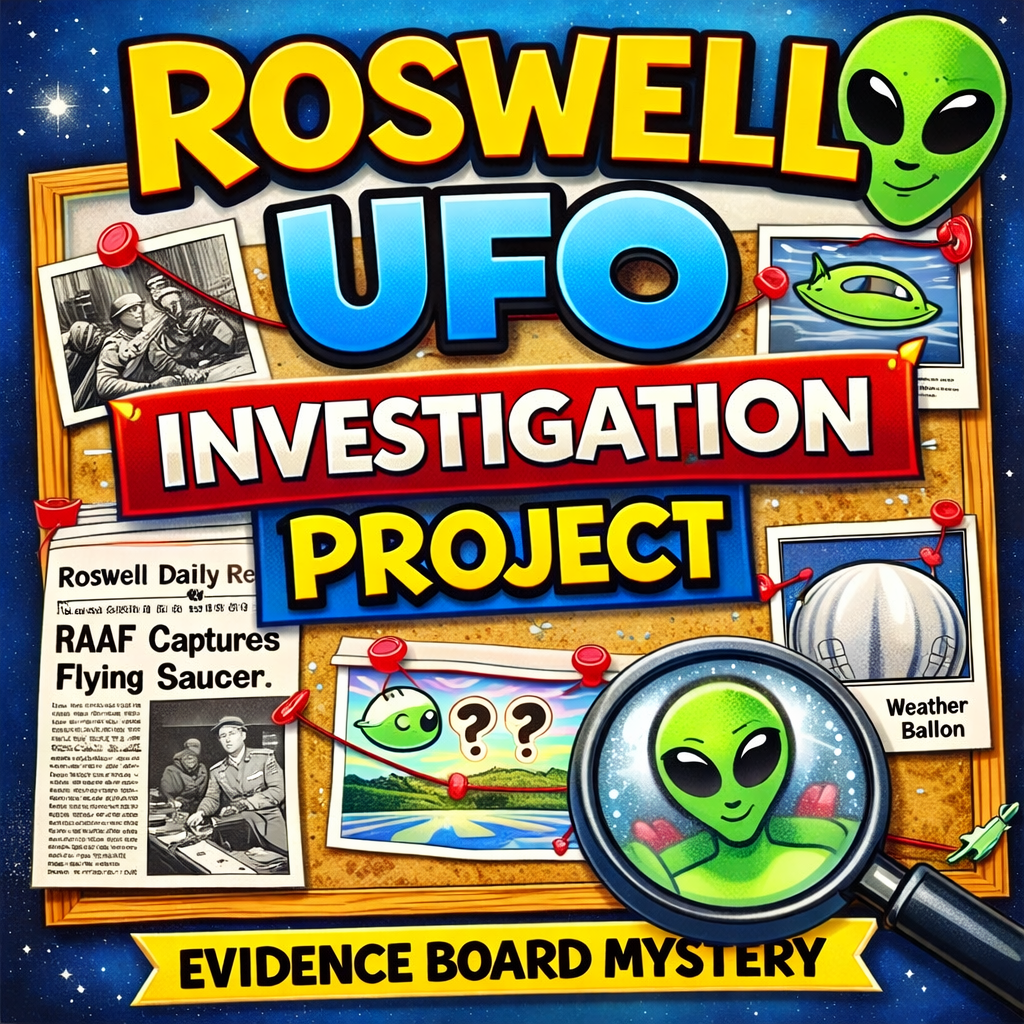
- What really happened in Roswell in 1947?
- Which city deserves the title “America’s Oldest City”?
- Was a historical decision fair?
- Why do witnesses describe the same event differently?
- Which sources can we trust?
- Whose story may be missing from the historical record?
These questions do not have simple, one-sentence answers—and that is exactly what makes them valuable for gifted learners.

Why Historical Investigations Work for Gifted Students
Gifted students often need more than additional facts or a longer assignment. They need opportunities to wrestle with complexity.
Historical investigations naturally provide that challenge because students must:
- Analyze primary and secondary sources
- Identify bias and point of view
- Separate facts from opinions
- Recognize contradictions
- Evaluate the credibility of evidence
- Consider multiple explanations
- Defend a conclusion
- Revise their thinking when new evidence appears
The goal is not for every student to reach the same conclusion. The goal is for every student to build a conclusion that can be supported with credible evidence.
That shift is powerful.
Students stop asking, “What answer does the teacher want?” and begin asking, “What does the evidence show?”
The Power of an Unsolved Question
A strong investigation begins with an open-ended question that creates genuine uncertainty.
For example, during a Roswell UFO investigation, students might examine newspaper articles, military statements, witness accounts, photographs, maps, timelines, and later explanations. Some pieces of evidence may support one theory while other pieces seem to contradict it.
Students quickly discover that history is not always a neat collection of undisputed facts. It is often a reconstruction of the past based on incomplete records, human memories, changing interpretations, and the evidence that survived.
The uncertainty creates intellectual tension. Gifted students want to resolve that tension, but they must learn that a strong conclusion does not require absolute certainty. It requires careful reasoning.
Multiple Perspectives Change the Investigation
One of my favorite ways to deepen a historical investigation is to assign different points of view.
Students might investigate an event as a:
- Historian
- Reporter
- Military official
- Government official
- Scientist
- Detective
- Local resident
- Skeptic
- Eyewitness
- Modern researcher
Each role encourages students to ask different questions.
A reporter may focus on what can be confirmed before publishing a story. A military official may consider public safety and national security. A historian may compare accounts and examine the larger historical context. A local resident may focus on how the event affected the community.
Students begin to understand that perspective influences which details people notice, which questions they ask, and how they interpret the same evidence.
This does not mean that every claim is equally reliable. Students must still determine whether a conclusion is supported by credible evidence.
Primary Sources Make History Feel Real
Primary sources can transform an investigation. Newspapers, photographs, maps, letters, advertisements, government records, interviews, radio transcripts, and eyewitness statements allow students to encounter traces of the past for themselves.
However, students need to learn that a primary source is not automatically accurate simply because it was created at the time of an event.
They should ask:
- Who created this source?
- When was it created?
- Why was it created?
- Who was the intended audience?
- What information does it provide?
- What information is missing?
- Could the creator have been mistaken?
- Does another source confirm this account?
These questions help students move beyond simply collecting information. They teach students how to evaluate information—a skill that is just as important today as it was in the past.
The Teacher’s Role Changes
During an investigation, the teacher does not need to become the keeper of the “correct” interpretation. Instead, the teacher becomes the facilitator of evidence-based thinking.
Useful teacher questions include:
- What makes you believe that?
- Which piece of evidence is strongest?
- Which source is most credible, and why?
- What evidence challenges your theory?
- Are you making an inference or stating a fact?
- What additional evidence would you like to have?
- Has your conclusion changed?
- What might another investigator say?
These questions push students to explain their reasoning without taking ownership of the investigation away from them.
A Strong Final Product
An investigation should end with more than a worksheet. Students need an opportunity to present and defend their conclusions.
Possible final products include:
- A Claim-Evidence-Reasoning verdict
- A case-file report
- A mock trial
- A museum exhibit
- A newspaper front page
- A documentary or podcast
- A press conference
- An evidence board
- A recorded news broadcast
- A debate between competing interpretations
The final product should require students to make a clear claim, select relevant evidence, explain how the evidence supports the claim, and address evidence that may point toward another conclusion.
History Becomes a Thinking Lab
Historical investigation projects do more than make history engaging. They teach students how knowledge is constructed.
Students learn that credible thinkers do not accept every claim, ignore conflicting evidence, or choose a conclusion simply because it is exciting. They ask questions. They verify information. They consider different perspectives. They remain willing to change their minds.
Those habits extend far beyond the history classroom.
When gifted students investigate the past, they are also practicing how to navigate the present. In a world filled with headlines, social media posts, persuasive messages, edited images, and competing claims, students need the ability to pause and ask:
What is the evidence, and can I trust it?
That may be one of the most important lessons we can teach.
Historical investigation projects turn the classroom into a place where curiosity is valued, uncertainty is welcomed, and students are trusted to think deeply.
History is no longer something that happened to other people a long time ago.
It becomes a mystery waiting to be investigated.
Think Bigger. Investigate Deeply. Follow the Evidence.

#smithingifted #GiftedEducation #HistoricalInvestigation #InquiryBasedLearning #PrimarySources #CriticalThinking #GiftedClassroom #ElementaryEducation #TeachingHistory #EvidenceBasedLearning

