When we think about gifted learners, it’s easy to focus on high test scores, advanced reading levels, or students who seem to know all the answers. But what if being gifted isn’t really about having the answers?
What if it’s about asking better questions?
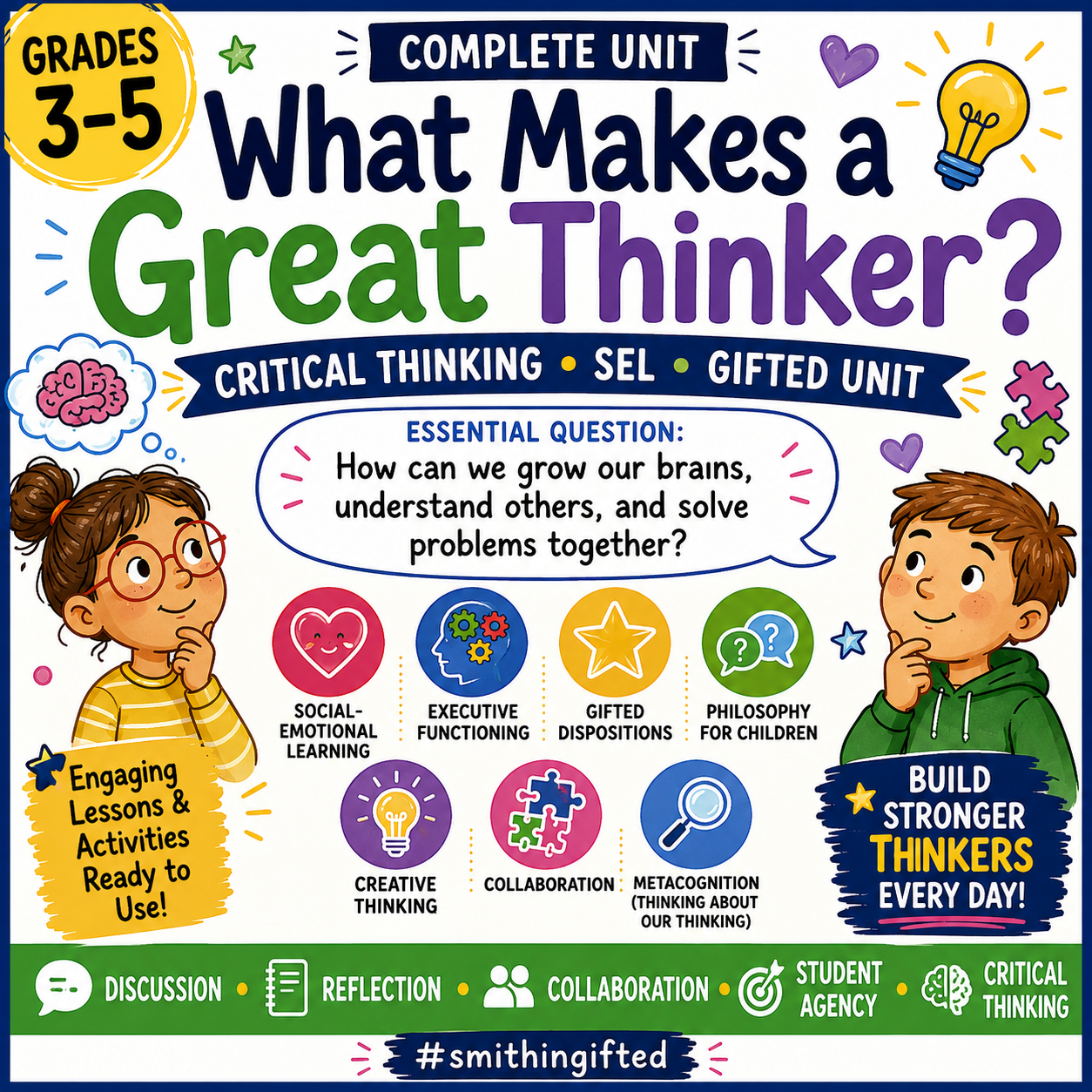
That’s the heart of What Makes a Great Thinker?, a social-emotional learning and critical thinking unit designed to help students become curious, reflective, resilient thinkers—not just high achievers.
Why Thinking Skills Matter More Than Ever
Today’s students are growing up in a world overflowing with information. Facts are only a Google search away, but understanding, evaluating evidence, considering different perspectives, and making thoughtful decisions are skills that require practice.
Research on gifted education consistently emphasizes that gifted learners thrive when teachers create opportunities for students to reason from evidence, defend their ideas, and wrestle with meaningful questions rather than simply memorize information.

These are the habits that prepare students not only for school but for life.
Beyond Academics: Teaching Students How to Think
Many gifted students learn quickly, but that doesn’t always mean they know how to:
- Reflect on mistakes
- Listen respectfully to different viewpoints
- Change their minds when presented with new evidence
- Ask thoughtful questions
- Think creatively when there isn’t one correct answer
- Work collaboratively to solve complex problems
These habits develop intentionally through discussion, reflection, and meaningful challenges.
Philosophy for Children (P4C): Big Questions, Big Growth
Children naturally ask incredible questions:
- What makes something fair?
- Can someone be brave and afraid at the same time?
- Is failure necessary for success?
- What makes a good friend?
- Can two people both be right?
These conversations build reasoning, empathy, communication, and confidence while encouraging students to support their ideas with evidence instead of simply stating opinions.
The goal isn’t finding the “right” answer.
The goal is learning to think deeply.
Social-Emotional Learning Meets Critical Thinking
Some people think SEL only focuses on emotions.
In reality, the strongest SEL lessons help students understand themselves while becoming better thinkers.
Students learn to:
- 🧠 Develop a growth mindset
- 💬 Communicate respectfully
- 🤝 Collaborate effectively
- ❤️ Understand different perspectives
- 🔍 Evaluate ideas carefully
- 💡 Generate creative solutions
- 🌎 Become thoughtful global citizens
These are the skills employers, colleges, and communities value most.
Perfect for Gifted and Advanced Learners
Gifted students often crave authentic discussions instead of worksheets with one correct answer.
This unit encourages students to:
- Defend their thinking with evidence
- Explore multiple perspectives
- Reflect on their own learning
- Engage in philosophical discussions
- Solve open-ended challenges
- Develop metacognition—thinking about their own thinking
Instead of asking, “Did I get it right?” students begin asking:
“Why do I believe this?”
That shift changes everything.
Classroom Benefits
Teachers love lessons that are engaging, meaningful, and easy to implement.
This unit works well for:
- Gifted pull-out programs
- Advanced elementary classrooms
- SEL instruction
- Morning meetings
- Advisory periods
- Philosophy for Children (P4C)
- STEM reflection lessons
- Inquiry-based learning
- Project-Based Learning (PBL)
The flexible format makes it easy to adapt for grades 3–8.
Growing Thinkers for the Future
Knowledge changes.
Technology changes.
Careers change.
But students who know how to think critically, collaborate respectfully, and solve problems creatively will always be prepared for whatever comes next.
Helping students become great thinkers may be one of the most valuable lessons we ever teach.
Explore the Resource
If you’re looking for meaningful lessons that combine social-emotional learning, philosophy, critical thinking, and gifted education, What Makes a Great Thinker? | SEL & Critical Thinking Unit | Gifted | Philosophy was created with curious learners in mind.
This unit helps students strengthen the habits that matter most—asking thoughtful questions, considering multiple perspectives, communicating respectfully, and becoming confident, independent thinkers.
Happy Teaching!

