Teaching Students to Think, Listen, and Lead Discussions
By Beth Smith, M. Ed. | #smithingifted
One of the greatest gifts we can give gifted students isn’t another worksheet—it’s the opportunity to think deeply and communicate their ideas.
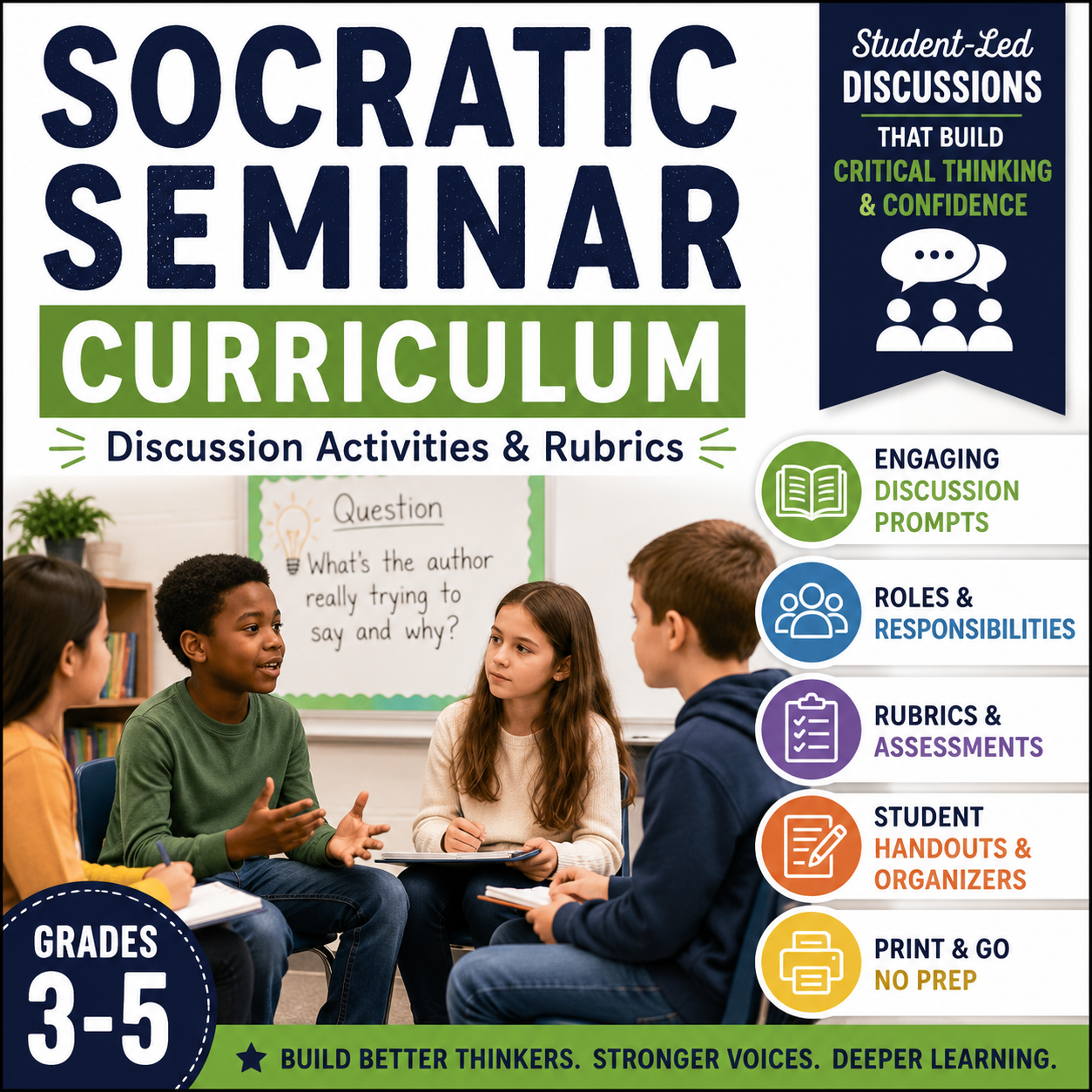
A Socratic Seminar transforms your classroom into a place where students ask thoughtful questions, support their opinions with evidence, respectfully challenge one another’s thinking, and build new ideas together.
For gifted learners, who often crave meaningful conversations and intellectual challenge, Socratic Seminars provide the perfect environment for developing higher-order thinking skills.
What Is a Socratic Seminar?
A Socratic Seminar is a structured discussion where students explore a complex question rather than search for one correct answer.
Instead of the teacher leading the conversation, students guide the discussion by:
- Asking questions
- Building on ideas
- Supporting claims with evidence
- Respectfully disagreeing
- Listening carefully
- Thinking critically
The teacher becomes a facilitator instead of the expert.
The goal isn’t winning an argument.
The goal is discovering new understanding together.
Why Gifted Students Love Socratic Seminars
Gifted learners often:
- Love debating ideas.
- Notice multiple perspectives.
- Ask “why” and “what if.”
- Enjoy solving open-ended problems.
- Thrive when discussions become complex.
A Socratic Seminar gives them permission to explore ideas instead of rushing toward a single answer.
What Does It Look Like?
Imagine walking into a classroom where students sit in a circle.
In the center is a question like:
Should humans ever change nature?
Instead of raising hands, students naturally respond to one another.
One student says,
“I think humans should protect nature but not control it.”
Another replies,
“I agree, but what about medicine? Isn’t creating vaccines changing nature?”
A third student adds,
“That makes me think about genetic engineering.”
Soon students are citing books, making real-world connections, asking questions, and respectfully challenging each other’s thinking.
The teacher speaks very little.
The students own the conversation.
How to Get Started
Step 1: Choose a Rich Topic
Great seminar topics don’t have one correct answer.
Examples:
- Should zoos exist?
- Is technology helping or hurting friendships?
- Should every community recycle?
- What makes someone a hero?
- Is failure necessary for success?
- Can robots make better decisions than humans?
- Should historical monuments ever be removed?
- Does exploration always improve society?
Step 2: Provide a Shared Experience
Students need something to discuss.
Use:
- A picture book
- A nonfiction article
- A science investigation
- A primary source
- A short video
- A historical photograph
- A current event
- A mystery
- A podcast
- Student-created research
Step 3: Teach Discussion Expectations
Practice:
✅ Listen to understand.
✅ Wait before responding.
✅ Use evidence.
✅ Respect different opinions.
✅ Build on others’ ideas.
Step 4: Start Small
Don’t expect a 30-minute discussion on Day One.
Try:
- Think-Pair-Share
- Small groups
- Half-circle discussions
- Fishbowl discussions
Gradually increase discussion time.
Classroom Setup
Arrange chairs in a circle so everyone can see one another.
Avoid desks between students if possible.
For larger classes, use a Fishbowl Model.
Inner Circle:
- Discusses.
Outer Circle:
- Observes.
- Takes notes.
- Tracks discussion skills.
- Gives feedback.
Then switch roles.
Teacher’s Role
Your job is not to answer questions.
Instead:
- Ask follow-up questions.
- Encourage quieter students.
- Redirect when needed.
- Keep discussion respectful.
- Let productive silence happen.
Sometimes the best teaching happens when you say nothing.
Socratic Seminar Sentence Starters
Agreeing
- I agree because…
- I noticed the same thing…
- That reminds me…
- I would like to add…
- Building on your idea…
Respectfully Disagreeing
- I see it differently because…
- Another possibility is…
- Could there be another explanation?
- What evidence supports that?
- I respectfully disagree because…
Asking Questions
- What makes you think that?
- Can you explain further?
- Where did you find that evidence?
- Why do you believe that?
- What would happen if…?
- Can you give an example?
- What are we missing?
Connecting Ideas
- This connects to…
- That reminds me of…
- I noticed a pattern…
- Another example is…
- I wonder if…
- This makes me think…
Encouraging Discussion
- Who has another perspective?
- Can someone build on that?
- Does anyone disagree?
- What evidence supports this?
- Is there another solution?
- Can someone summarize what we’ve discovered?
Great Socratic Seminar Questions
Literature
- What makes someone a hero?
- Why do characters make poor choices?
- How does conflict change people?
- Is every villain really a villain?
Science
- Should humans explore space?
- Should extinct animals be brought back?
- Is climate change everyone’s responsibility?
- Can technology solve every environmental problem?
Social Studies
- What makes a good leader?
- Should historical figures be judged by today’s standards?
- Why do civilizations rise and fall?
- Does freedom require responsibility?
STEM
- Could robots replace teachers?
- Should AI make important decisions?
- Can inventions create new problems?
- Should every invention be built simply because we can?
Creativity
- Is imagination more important than knowledge?
- Can mistakes lead to innovation?
- Does every problem have more than one solution?
- What does it mean to think differently?
Assessment Ideas
Instead of grading right or wrong answers, assess discussion skills.
Students can earn points for:
- Using evidence
- Asking thoughtful questions
- Building on ideas
- Respectful disagreement
- Active listening
- Staying on topic
- Including others
- Making real-world connections
Tips for Success
⭐ Begin with low-risk topics.
⭐ Celebrate curiosity.
⭐ Allow wait time.
⭐ Encourage students to reference evidence.
⭐ Teach respectful disagreement.
⭐ Resist the urge to rescue the conversation.
⭐ Reflect after every seminar.
Final Thoughts
Gifted students don’t simply need harder work—they need richer thinking.
A Socratic Seminar shifts the focus from memorizing information to exploring ideas. It gives students the chance to question, wonder, analyze, and grow together as thinkers.
When students leave a seminar with more questions than answers, you’ve likely done it right.
Because in gifted education, the goal isn’t simply learning facts.
It’s learning how to think.
What are your favorite Socratic Seminar questions? Share them in the comments!

