By Beth Smith, M. Ed. | #smithingifted
Twenty-five years.
For today’s elementary students, September 11, 2001 can feel like ancient history.
They were not alive.
Their teachers may have been children themselves.
And the adults who vividly remember exactly where they were that morning are now carrying stories that our students may never hear unless we intentionally ask them to share.
That is what makes the 25th anniversary of September 11 such an important opportunity for educators.
Instead of teaching September 11 only through dates, photographs, videos, and textbook passages, we can invite students to do something historians actually do:
Listen. Ask questions. Collect stories. Analyze perspectives. Preserve history.
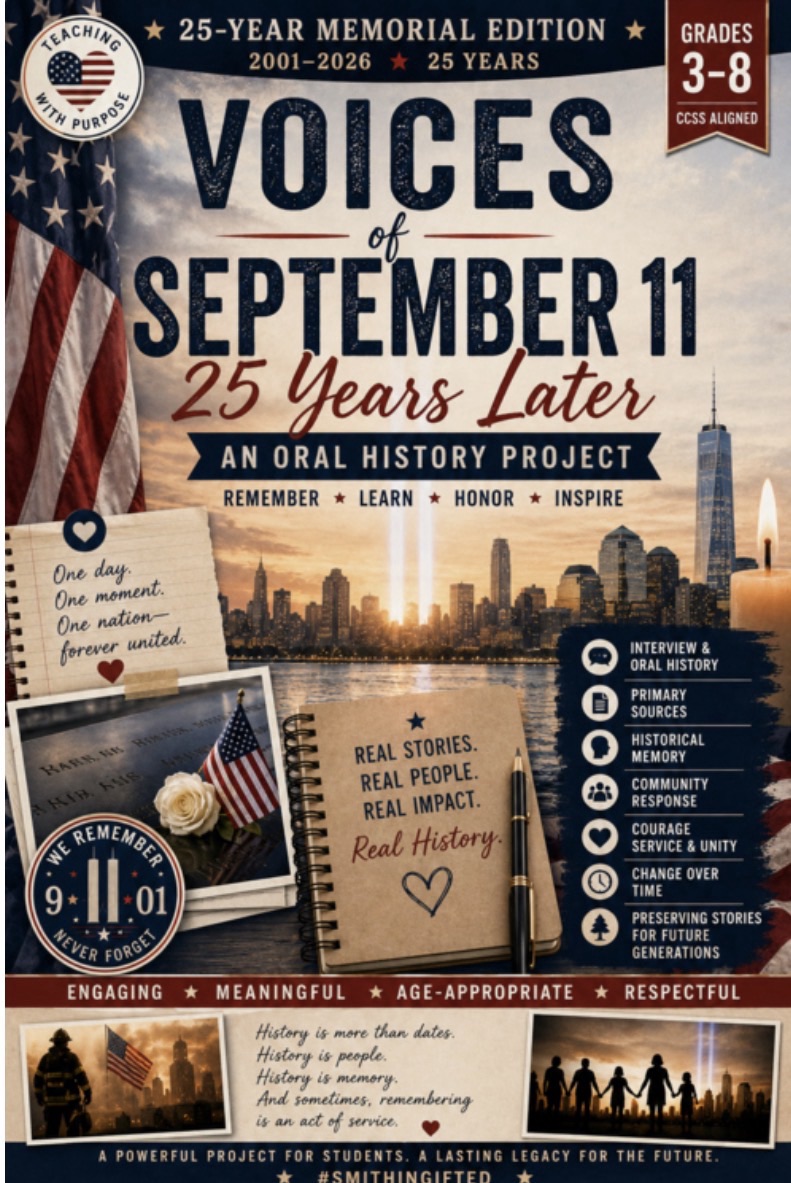
That is the purpose behind my 9/11 25th Anniversary Oral History Project for students in grades 3–6.
Why Oral History?
When we teach history, students often encounter major events as a collection of facts:
September 11, 2001.
Four airplanes.
New York City.
Washington, D.C.
Pennsylvania.
The World Trade Center.
The Pentagon.
But history is much more than a list of facts.
History is also the experience of ordinary people living through extraordinary moments.
Ask an adult who remembers September 11 where they were when they first heard what was happening, and there is a good chance they can still tell you.
They may remember the classroom they were sitting in.
The television that was turned on.
The phone call they received.
The silence in a workplace.
The conversations around a dinner table.
The flags that appeared throughout their community in the days that followed.
Those memories help students understand something a textbook cannot fully communicate:
Historical events happen to real people.
That is where oral history becomes incredibly powerful.
The Essential Question
The project is built around one central question:
How can personal stories help us understand an important moment in history?
Students become oral historians by interviewing a trusted adult who remembers September 11, 2001.
That person might be a:
- parent
- grandparent
- relative
- neighbor
- family friend
- teacher
- coach
- community member
Students aren’t simply asking, “What happened?”
They are investigating:
What did you experience?
What did you notice?
How did people respond?
What changed afterward?
And perhaps most importantly:
What do you think students 25 years later should understand about that time?
Moving Students From Consumers of History to Historians
One of my favorite things about project-based learning is giving students a different role.
Instead of saying:
Read this information and answer the questions.
We can say:
You are the historian.
Suddenly the thinking changes.
Students have to determine which questions matter.
They have to listen carefully.
They have to record information accurately.
They have to separate fact from memory and perspective.
They have to look for patterns.
They have to consider what one person’s account can—and cannot—tell us about an event.
That is much deeper thinking than simply memorizing information for a quiz.
Before the Interview
Students begin by preparing for their interview.
This step matters.
Good historians do not simply start asking random questions.
They consider:
Who am I interviewing?
Why might this person’s perspective be valuable?
What do I already know about September 11?
What would I like to understand better?
Students can also discuss appropriate interview behavior:
Listen without interrupting.
Ask follow-up questions when appropriate.
Record the person’s words accurately.
Be respectful.
Understand that some memories may be emotional.
And recognize that an interviewee can always choose not to answer a question.
That last piece is especially important when teaching September 11.
Keeping a Difficult Topic Age-Appropriate
One of the challenges of teaching 9/11 in elementary school is determining how much students actually need to see and know.
More graphic information does not automatically create deeper understanding.
For younger students especially, I would rather focus instruction on themes such as:
courage
service
community
empathy
historical memory
change over time
multiple perspectives
primary sources
Students can understand the significance of September 11 without being exposed to graphic images or disturbing details.
In this project, students and interview participants are specifically reminded that they may skip questions and do not need to discuss upsetting details.
The goal is historical understanding—not shock value.
“Where Were You?”
One of the most powerful sections of an oral history interview can also be one of the simplest:
Where were you when you first heard about September 11?
Students quickly discover that answers vary tremendously.
Someone may have been:
in elementary school,
at college,
at work,
driving,
at home,
serving in the military,
traveling,
or caring for young children.
Those different experiences naturally introduce an important historical thinking concept:
Perspective.
Two people can experience the same historical event and remember it very differently.
And different does not necessarily mean wrong.
That opens the door to fantastic classroom conversations about memory, evidence, perspective, and historical interpretation.
What Happened in the Days After?
September 11 is not only a story about what happened during several hours on one Tuesday morning.
Students should also investigate what happened afterward.
Interviewees might remember:
American flags appearing throughout neighborhoods.
Community gatherings.
People donating blood.
First responders being honored.
Churches and community organizations helping families.
Changes in travel.
Changes at airports.
Changes in security.
Changes in the news.
Changes in how Americans thought about safety.
These memories help students investigate cause and effect rather than simply identifying an event.
What Changed Between 2001 and 2026?
This is where the project can become especially powerful for gifted students.
Students research something mentioned during their interview and compare:
THEN — 2001
with
NOW — 2026
Possible topics include:
- airport security
- air travel
- communication
- cell phones
- television news
- social media
- emergency response
- military technology
- government security
- community preparedness
- journalism
- patriotism
Students investigate three deceptively complex questions:
What changed?
What stayed the same?
Was every change positive?
That final question changes the assignment.
Students are no longer merely identifying differences.
They are evaluating consequences.
For gifted learners, this is exactly the kind of complexity we should be encouraging.
Memory vs. History
Another important concept students explore is the difference between memory and history.
A firsthand account is incredibly valuable.
But it is still one person’s perspective.
Memory can be influenced by:
age,
location,
emotion,
information available at the time,
personal experience,
and the passage of time.
Students begin considering questions such as:
Does remembering something make it a fact?
Can two people remember the same event differently?
What should historians do when accounts disagree?
Why should we compare oral histories with other primary and secondary sources?
Now we are moving far beyond a September 11 worksheet.
We are teaching students how knowledge itself is constructed.
Create a Class Oral History Archive
One of my favorite extensions is creating a class collection:
Voices of September 11: 25 Years Later
Each student contributes one meaningful idea, quotation, lesson, or memory from their interview.
The class can transform those contributions into a:
- memorial display
- class book
- historical timeline
- podcast
- digital archive
- remembrance exhibit
Imagine having 25 students.
Instead of learning one account of September 11, your classroom could preserve 25 different perspectives.
That collection becomes a primary source created by your students.
Send a Message to 2051
There is another piece of this project that I especially love.
Students think about the future.
The year 2026 marks 25 years since September 11.
Twenty-five years from now will be 2051—the 50th anniversary.
Students consider:
What should students in 2051 know about September 11?
That question forces them to determine what matters.
Not every fact can be preserved.
Not every story will survive.
So students must decide:
What is worth remembering?
That is historical thinking at a very high level.
Why This Works So Well With Gifted Learners
Gifted students generally do not need more facts simply because they can learn them quickly.
They need opportunities to wrestle with complexity.
An oral history investigation naturally introduces:
Multiple perspectives
Different people experience the same event differently.
Source analysis
Firsthand accounts are valuable, but they still need to be examined critically.
Cause and effect
Students investigate how September 11 influenced later policies, technology, travel, security, and society.
Change over time
Students compare life in 2001 with life in 2026.
Unintended consequences
Students consider whether every change resulting from an event was necessarily positive.
Evidence-based reasoning
Students must distinguish what an interviewee knows, remembers, believes, or interprets.
That is the kind of thinking I want happening in a gifted classroom.
You Don’t Need to Turn September 11 Into a Lecture
Teachers sometimes feel tremendous pressure when approaching September 11.
We want to teach it respectfully.
We want students to understand its significance.
But we also don’t want to overwhelm younger learners.
One solution is to stop feeling like we have to tell students everything.
Instead, give them a powerful question.
Give them the tools of a historian.
And let them investigate.
A student sitting across from a grandparent and asking,
“What do you remember?”
may learn more about history in that conversation than they would from another slideshow.
And there is an added benefit.
They listened to someone.
Really listened.
That matters too.
About the 9/11 25th Anniversary Oral History Project
I created the 9/11 25th Anniversary Oral History Project as an age-appropriate way to help students explore September 11 through firsthand accounts, primary source analysis, historical thinking, reflection, and change over time.
The resource includes interview preparation and questions, historical analysis activities, a Then & Now Gifted Level-Up, Memory vs. History thinking, a 25-year reflection, a future message to students in 2051, a class oral history archive activity, teacher guidance for approaching September 11 sensitively, and more.
It can work especially well for:
Grades 3–6 • Gifted Education • U.S. History • Patriot Day • Primary Sources • Project-Based Learning • Historical Thinking • September Lessons • Family Interview Projects
🇺🇸 9/11 25th Anniversary Oral History Project | Grades 3–6
Available from smithingifted on Teachers Pay Teachers.
One Final Thought
Twenty-five years after September 11, there are millions of people who can still begin a sentence with:
“I remember…”
Our students cannot.
But they can listen.
They can ask.
They can preserve.
They can analyze.
And they can carry those stories forward.
Because history is more than dates.
History is people.
History is memory.
And sometimes, remembering is an act of service.
#smithingifted
Suggested SEO Keywords:
9/11 lesson plans, September 11 activities, 9/11 activities for elementary students, September 11 oral history project, 9/11 25th anniversary lesson, Patriot Day activities, September 11 project grades 3–6, gifted social studies activities, primary source activities, oral history project, September social studies lessons, 9/11 gifted education, historical thinking activities, project-based learning social studies
The TPT listing confirms the project includes the Then & Now Gifted Level-Up, class oral history archive, Memory vs. History analysis, future message to 2051, and guidance for teaching the topic sensitively, so I leaned heavily into those features rather than making the post feel like a generic 9/11 lesson advertisement.

View the 9/11 25th Anniversary Oral History Project on TPT