By Beth Smith, M. Ed. | #smithingifted
One question that sometimes comes up in gifted education is:
Why do you grade assignments if they don’t go on a report card?
In my #smithingifted classroom, grades are not about punishing students, stressing them out, or turning gifted education into “one more class” with a traditional grade. Instead, the grades I give on student assignments are used as a tool for feedback, accountability, documentation, and progress monitoring.
Gifted services may not always show up as a traditional report card grade, but that does not mean student growth should go undocumented.
Gifted Work Still Matters
Gifted students deserve meaningful learning experiences that challenge them to think deeply, create original work, solve problems, and reflect on their progress. When students complete assignments in #smithingifted, they are often working on skills that go far beyond a simple worksheet or right/wrong answer.
They may be:
- Designing a STEM solution
- Coding a robot
- Creating a research-based project
- Solving advanced math problems
- Participating in Battle of the Books
- Building a prototype
- Writing a reflection
- Working through a design challenge
- Creating something original
- Practicing collaboration and perseverance
These assignments show how students think, problem-solve, create, communicate, and grow.
That kind of work deserves feedback.

Grades Help Students Understand Expectations
In #smithingifted, grades help students understand the quality of their work and where they are in the learning process.
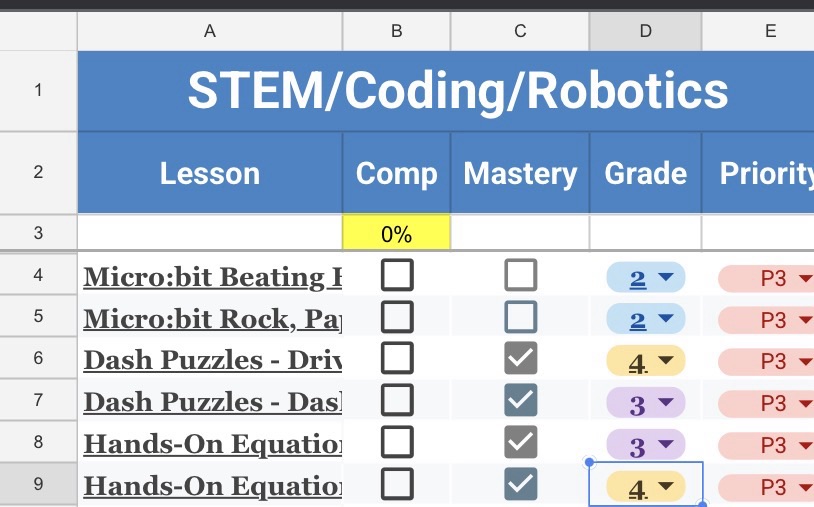
Because gifted students often work at different paces and levels, I use a simple 1–4 grading system. This keeps the focus on growth instead of points, percentages, or perfection.
The goal is not for every student to get a 4 on every assignment. The goal is for students to understand what strong work looks like and how they can continue improving.
The #smithingifted 1–4 Grading System
Here is the basic grading system I use:
1 — Beginning
A score of 1 means the assignment is incomplete, rushed, missing important parts, or shows very little understanding of the task.
This tells me the student may need more support, more time, reteaching, or a clearer understanding of the expectations.
A 1 does not mean the student is “bad” at gifted. It means the work does not yet show the level of thinking or effort expected for that assignment.
2 — Developing
A score of 2 means the student is starting to understand the task, but the work still needs improvement.
The assignment may be partially complete, missing details, lacking depth, or showing surface-level thinking. The student is on the right track, but the work needs more effort, stronger reasoning, or better completion.
A 2 tells me the student is developing the skill but is not quite where they need to be yet.
3 — Proficient
A score of 3 means the student completed the assignment well and met the expectations.
The work shows understanding, effort, and appropriate depth for the task. The student followed directions, included important details, and demonstrated the skill or concept being practiced.
In #smithingifted, a 3 is a strong score. It means the student did what was expected and completed quality work.
4 — Advanced
A score of 4 means the student went above and beyond the basic expectations.
The work may show exceptional creativity, deeper thinking, strong problem solving, original ideas, leadership, or a high level of independence. A 4 shows that the student extended the assignment or demonstrated advanced understanding.
A 4 is not about being perfect. It is about showing depth, creativity, and meaningful effort beyond the basic requirements.
Why I Don’t Use Traditional Percentages
Traditional percentages do not always make sense in a gifted classroom. A student could miss one small part of a creative project and suddenly the grade does not accurately reflect their thinking. Another student could complete everything quickly but with very little depth.
Gifted assignments often involve creativity, problem solving, persistence, collaboration, and innovation. Those skills are better measured with a simple rubric-style system than with a traditional percentage grade.
The 1–4 system allows me to look at the whole assignment and ask:
Did the student understand the task?
Did they show effort?
Did they think deeply?
Did they complete the work?
Did they apply the skill?
Did they create, problem-solve, or extend their thinking?
That gives me much better information than a percentage alone.
Grades Help With Progress Reports
One of the biggest reasons I grade assignments in #smithingifted is because it helps me when I fill out student progress reports.
Progress reports should be based on evidence, not just memory. When I sit down to write about a student’s progress, I need to know how they are actually performing across multiple assignments and learning experiences.
The 1–4 grades help me see patterns such as:
- Is the student completing assignments?
- Does the student rush through work?
- Is the student showing depth and creativity?
- Does the student need help with perseverance?
- Is the student taking risks?
- Does the student work independently?
- Is the student improving over time?
- Does the student need support with organization or follow-through?
- Is the student consistently producing advanced work?
This information helps me write more accurate, meaningful progress reports for parents and guardians.
Instead of saying, “Your child is doing fine,” I can give specific feedback about how the student is growing as a thinker, creator, collaborator, and problem solver.
Grades Create Accountability
Gifted students need freedom, creativity, and choice — but they also need accountability.
Sometimes gifted students are used to things coming easily. When work becomes more open-ended, challenging, or long-term, they may need support learning how to manage time, revise their work, and complete assignments with quality.
The 1–4 grading system helps students understand that their work matters, even if it does not appear as a traditional report card grade.
It also helps students see that gifted education is not just “fun time” or “extra activities.” It is a place where they are expected to think, create, struggle productively, and grow.
Grades Are Feedback, Not Final Labels
The most important thing to understand is that grades in #smithingifted are not final labels.
A 1 does not mean a student is not gifted.
A 2 does not mean a student is failing.
A 3 does not mean a student is average.
A 4 does not mean a student is perfect.
The scores are simply feedback.
They help students understand where they are, what they need to improve, and how they can grow. They also help me track progress over time and provide families with better information.
What I Want Students to Learn
At the heart of #smithingifted, I want students to learn that quality matters.
I want them to know that their ideas matter, their effort matters, their creativity matters, and their growth matters.
The 1–4 grading system helps make that visible.
It gives students a clear way to understand expectations. It gives me documentation for progress reports. Most importantly, it helps keep gifted learning focused on growth, rigor, creativity, and meaningful challenge.
Even when gifted assignments do not go on a report card, they still tell an important story.
And that story deserves to be documented.