By Beth Smith, M.Ed. | #smithingifted
What if your students walked into class and discovered they weren’t students for the day?
They were investigators.
Their assignment?
Examine the evidence surrounding one of America’s most famous mysteries and decide for themselves:
What really happened near Roswell, New Mexico, in 1947?
Suddenly, social studies isn’t about memorizing names, places, and dates. Students are reading newspaper articles, examining photographs, comparing witness statements, questioning official explanations, and trying to determine which sources they can trust.
And that’s exactly where I want my gifted students to be—questioning, analyzing, debating, and thinking.
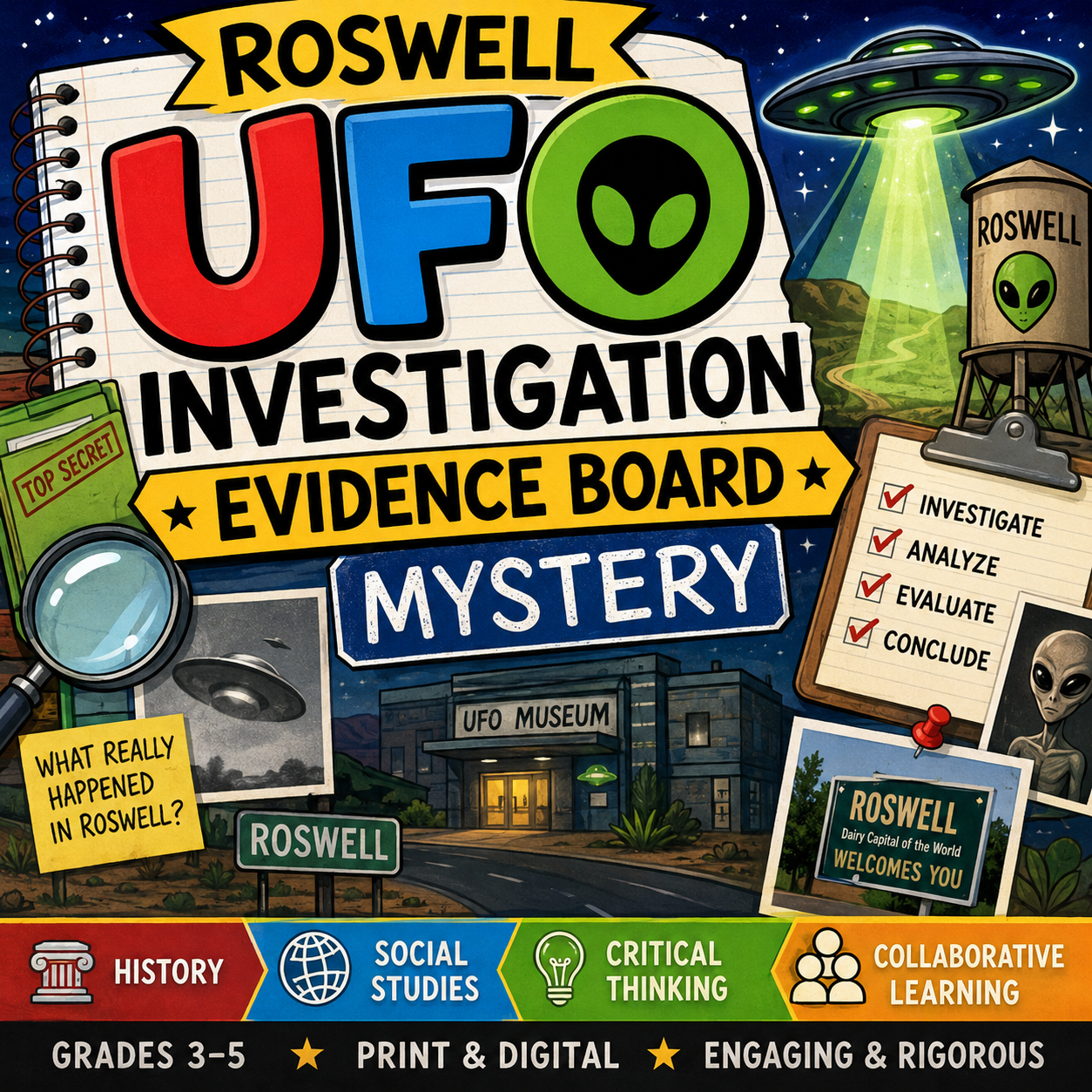
Welcome to the Roswell UFO Investigation Project. 🛸🔎
📚 What Happened in Roswell?
In July 1947, something unusual was discovered on a ranch northwest of Roswell, New Mexico.
The Roswell Army Air Field initially issued a statement announcing that personnel had recovered a “flying disc.” Shortly afterward, the military said the recovered material was actually from a weather balloon.
Those conflicting explanations helped create a mystery that continues to fascinate people decades later.
Over time, witnesses, researchers, government officials, historians, UFO enthusiasts, and skeptics have offered different interpretations of what happened.
For students, that creates an incredible opportunity.
I’m not interested in telling them which version they should believe.
I want them to investigate the evidence themselves.
🔎 Turn the Classroom Into an Investigation
Instead of beginning the lesson with a textbook passage explaining the Roswell incident, students receive a case file.
The classroom can even become an evidence room.
Students investigate materials such as:
- 📰 Newspaper articles
- 📻 Radio reports and transcripts
- 📸 Historical photographs
- 🪖 Military statements
- 🗣️ Witness accounts
- 🗺️ Maps
- 📄 Government documents
- 📝 Research notes
- ⏱️ Timelines
- ❓ Conflicting claims
Students aren’t simply reading the sources.
They’re interrogating them.
Who created this?
When was it created?
Why was it created?
Is this a primary or secondary source?
What does this source actually prove?
What doesn’t it prove?
Could the person who created it have a reason to leave something out?
Those questions turn a fun historical mystery into a rigorous source-analysis lesson.
👀 The Same Evidence—Different Conclusions
One of my favorite parts of this investigation is assigning students different points of view.
Students might investigate the case as a:
- 🪖 Military representative
- 📰 Reporter
- 👨🌾 Rancher
- 🕵️ Detective
- 🔎 Investigator
- 🏛️ Government official
- 📚 Historian
- 👽 UFO believer
- 📻 Radio announcer
- 🧒 Child living in Roswell in 1947
- 💻 Modern researcher
Everyone may examine many of the same pieces of evidence, but their perspectives can lead them to ask different questions.
Then I pose one of the most important questions in the entire investigation:
If everyone sees the same evidence, why don’t they all reach the same conclusion?
Now we’re getting somewhere.
Students begin recognizing that perspective matters.
A reporter may focus on what makes a compelling story.
A military official may prioritize national security.
A rancher may focus on what they personally observed.
A historian may want corroborating evidence before accepting a claim.
A UFO believer may interpret unexplained evidence differently from a skeptic.
The evidence hasn’t necessarily changed.
The lens through which someone examines it has.
🧠 This Isn’t Really a Lesson About Aliens
The UFO mystery gets students through the door.
But aliens aren’t actually the most important part of this lesson.
The real learning is about information literacy.
Students are learning to:
- Separate fact from opinion.
- Identify primary and secondary sources.
- Recognize bias.
- Evaluate credibility.
- Compare conflicting accounts.
- Corroborate information across sources.
- Identify missing evidence.
- Distinguish evidence from inference.
- Recognize uncertainty.
- Defend conclusions with evidence.
Those are social studies skills.
They’re also life skills.
⚖️ Not All Evidence Is Equal
Here’s where I like to increase the rigor.
Give students several pieces of evidence and ask them to rank them:
Most Reliable → Least Reliable
Then comes the important part:
They have to defend their ranking.
A firsthand account isn’t automatically reliable simply because someone says, “I saw it.”
An official government statement isn’t automatically correct because it came from the government.
A newspaper isn’t automatically unbiased because it was published in 1947.
A modern documentary isn’t automatically more accurate because it contains more information.
Students have to consider:
How close was this person to the event?
When did they tell their story?
Has the account changed?
Can another source confirm it?
Does the source distinguish what is known from what is assumed?
That’s sophisticated historical thinking—even for elementary students.
🗂️ Build an Evidence Board
This investigation becomes especially engaging when students physically organize their evidence.
Create categories such as:
✅ CONFIRMED
Information supported by strong historical evidence.
❓ POSSIBLE
Information that could be true but isn’t fully supported.
⚠️ QUESTIONABLE
Claims with credibility problems or conflicting evidence.
🔍 NEED MORE EVIDENCE
Questions students cannot answer with the information currently available.
That last category is incredibly important.
Gifted students sometimes feel pressure to find the answer.
But authentic research doesn’t always produce one.
Sometimes the strongest conclusion a researcher can make is:
We don’t have enough reliable evidence to know yet.
That’s not avoiding the question.
That’s intellectual honesty.
💥 Add a Surprise Evidence Drop
Want to make the investigation even better?
After students have developed their theories, give them one new piece of evidence.
Don’t tell them what to think about it.
Simply announce:
🚨 NEW EVIDENCE HAS BEEN ADDED TO THE CASE.
Then ask:
Does this evidence strengthen your conclusion, weaken it, or require you to change your thinking?
This is where things get interesting.
Students sometimes become attached to their original theories. New evidence forces them to confront an important question:
Am I trying to prove I’m right—or am I trying to figure out what the evidence supports?
That’s a powerful distinction.
✍️ Finish With Claim-Evidence-Reasoning
At the conclusion of the investigation, students write a CER response.
Claim
What do you believe most likely happened near Roswell in 1947?
Evidence
What are your strongest pieces of evidence?
Reasoning
How does that evidence support your conclusion?
But I add another component:
Unanswered Questions
What information would you still need before you could be more confident in your conclusion?
That final question keeps students from treating historical investigation as a simple puzzle with a guaranteed answer.
🎤 Put the Case on Trial
For an additional gifted extension, hold a Roswell Evidence Hearing.
Students present their findings to a panel.
Other students can challenge them:
“What evidence supports that?”
“How do you know that source is reliable?”
“Is there another explanation?”
“Which source contradicts your claim?”
“What evidence would make you change your mind?”
Now students aren’t merely presenting projects.
They’re defending ideas under questioning.
That’s a very different level of thinking.
🌎 From Roswell 1947 to Information Literacy Today
This may be the most important connection of the entire project.
Our students live in a world overflowing with information.
They encounter:
- Social media posts
- AI-generated content
- Videos
- Headlines
- Advertisements
- Influencers
- News reports
- Memes
- Screenshots
- Viral claims
Being able to find information isn’t enough anymore.
Students need to know how to evaluate it.
If students learn to question a newspaper article from 1947, compare conflicting military statements, examine a witness’s credibility, and search for corroborating evidence, they’re practicing the same thinking skills they need when encountering questionable information today.
Before asking:
“Do I believe this?”
I want students to learn to ask:
“What evidence supports this?”
That’s a habit worth developing early.
🌟 Why This Works So Well With Gifted Learners
Gifted students don’t always need more information.
They need opportunities to do more with information.
Give them ambiguity.
Give them conflicting evidence.
Give them multiple perspectives.
Give them unanswered questions.
Give them permission to disagree.
And then require them to prove their thinking.
The Roswell UFO Investigation provides exactly that kind of intellectual challenge.
Students aren’t trying to guess the answer their teacher wants.
They’re constructing an argument based on evidence—and recognizing that another student may construct a different, equally defensible argument.
That’s when classroom discussion gets really good. 🔥
🛸 So…What Really Happened at Roswell?
That’s exactly the question I don’t answer for my students.
I give them the case.
I give them the evidence.
I teach them how to evaluate sources.
Then I tell them:
You decide.
Because the most valuable outcome isn’t whether a student concludes it was a balloon, a secret military project, a spacecraft, or something else entirely.
It’s whether that student can say:
“Here’s what I think happened—and here’s the evidence that led me there.”
That’s the kind of thinking I want happening in my gifted classroom.
And if a little UFO mystery gets us there?
Even better. 👽🛸
Happy investigating!
Beth Smith, M.Ed.
#smithingifted

