By Beth Smith, M.Ed. | #smithingifted
When people walk into my gifted classroom for the first time, one of the first things they notice is that it doesn’t look like a traditional classroom.
There aren’t rows of desks facing the front of the room.
Instead, they see students building, designing, programming, collaborating, researching, and creating. My classroom functions more like an innovation workshop—a flexible learning space where students have the freedom to move, explore, and choose the tools they need to solve problems.
That design is intentional.
Learning Doesn’t Always Happen Sitting at a Desk
Gifted learners thrive when they can investigate, create, and think independently. Some lessons require collaboration around a table. Others require floor space to test robots, quiet corners for reading, or open areas for building prototypes.
Rather than expecting every student to learn in the same way, my classroom adapts to the learning experience.
The room changes with the lesson—not the other way around.
A Classroom Designed for Exploration
Every area of the room has a purpose and supports a different kind of thinking.
🤖 Robotics Station
Students explore coding and engineering with robots, learning programming, problem-solving, and computational thinking through hands-on challenges.
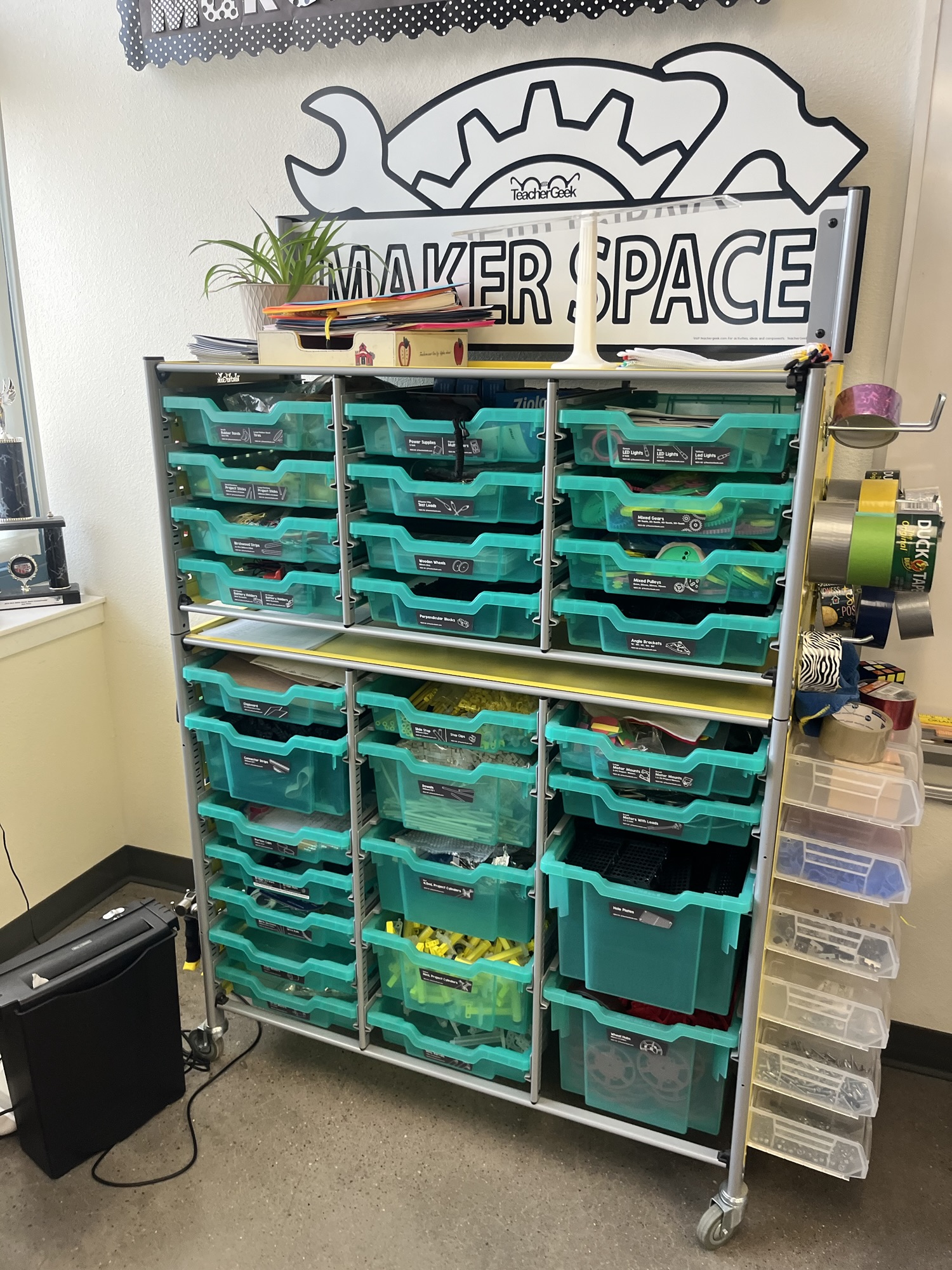
🛠️ Makerspace
Filled with building materials and creative tools, the makerspace encourages students to prototype, invent, test ideas, and improve their designs using the Engineering Design Process.
🧱 LEGO Engineering Area
LEGO isn’t just for play. Students design structures, solve engineering challenges, and develop spatial reasoning while collaborating with classmates.
🚁 Drone Center
Students learn about flight, technology, and responsible drone operation while completing engaging STEM missions.
📦 Supply Station
Having classroom materials organized and easily accessible encourages independence. Students know where to find what they need and can get started without waiting for directions.
🛋️ Flexible Seating
Beanbags and other flexible seating options give students choices about where they work best. Sometimes the most creative thinking happens in a comfortable reading corner instead of a traditional chair.
♟️ Chess Corner
Chess develops strategic thinking, perseverance, planning, and decision-making. Students often gather here to challenge one another and strengthen their thinking skills.
💻 Chromebook Cart
Technology is always within reach, allowing students to research, code, collaborate, create presentations, and document their learning whenever needed.
📚 Classroom Library
The library provides access to high-interest books, STEM resources, biographies, and research materials that spark curiosity and support independent inquiry.
🖥️ Interactive Learning Space
Our Promethean Board serves as a collaborative workspace where students analyze information, brainstorm ideas, share projects, and learn together.
🔬 STEM Resources
Engineering kits, electronics, coding tools, and science materials are organized so students can quickly access what they need for investigations and projects.
➗ Math Manipulatives
Gifted mathematicians benefit from hands-on exploration. Manipulatives help students visualize concepts, investigate patterns, and solve complex problems.
🎨 Creative Arts Area
Innovation often begins with a sketch. Art supplies allow students to design prototypes, illustrate ideas, create models, and communicate their thinking creatively.
🤝 Collaboration Tables
Large tables become workspaces for engineering, robotics, research, debates, design challenges, and project-based learning. They are places where ideas grow through teamwork.
Why an Innovation Workshop Works
A flexible classroom encourages students to make decisions about their own learning.
Instead of asking, “Where do I sit?” students ask:
- What tools do I need?
- Where will I work best?
- Who should I collaborate with?
- How can I improve my design?
Those are the kinds of questions that lead to authentic learning.
More Than a Classroom
My goal has never been to create the perfect classroom.
My goal is to create an environment where gifted students feel empowered to think differently, take intellectual risks, and turn ideas into reality.
When students walk through the door, I want them to know they’re entering a place where curiosity is celebrated, creativity is expected, and every challenge is an opportunity to learn.
That’s why I don’t think of my room as a classroom.
I think of it as an innovation workshop where tomorrow’s engineers, scientists, designers, entrepreneurs, and problem-solvers begin their journey.
How have you designed your classroom to encourage creativity and student ownership? I’d love to hear your ideas in the comments!
Happy Innovating!

